Remote Machine Learning Jobs: 7 Proven Strategies to High-Paying Roles

Summary:
Remote machine learning jobs are transforming how professionals build AI-powered systems from anywhere globally. This guide reveals proven strategies to secure top-tier positions, master essential skills, and thrive in the booming field of machine learning remote jobs where six-figure salaries and flexible schedules await talented professionals ready to shape the future of artificial intelligence.
Key Takeaways:
- Remote machine learning jobs worldwide offer salaries ranging from $120,000 to $400,000+ annually with unmatched flexibility.
- Python, TensorFlow, PyTorch, and deep learning expertise form the foundation for securing remote ML positions.
- Machine Learning Engineers can work from home while building cutting-edge AI systems.
- Healthcare, finance, manufacturing, and autonomous vehicle sectors desperately need remote machine learning talent.
- Continuous learning through research papers, online courses, and open source projects keeps your skills competitive.
- Remote collaboration tools and strong communication abilities are as critical as technical prowess.
- Machine learning remote jobs combine competitive compensation with work-life balance that traditional roles can’t match.
Introduction:
Remote machine learning jobs have exploded in the past few years, and remember when working from home seemed like a distant dream? Now, you can build neural networks in your pajamas while sipping coffee in California or coding algorithms from a beach in Bali, with no restrictions on geographic boundaries.
Here’s something that surprised me: companies now hire machine learning engineers without ever meeting them face-to-face – all while working remotely. The shift happened fast, and it’s permanent.
Artificial intelligence isn’t slowing down. Organizations need talented professionals who understand algorithms, can wrangle massive datasets, and build systems that learn from data. The catch? Most companies don’t care where you sit while you do it. They care about results.
This guide reveals exactly how you can break into this field or level up your existing career. I’ll show you which roles pay the most, which skills matter most, and how to stand out when hundreds of applicants compete for the same position.
The Shifting Landscape of Remote Machine Learning:
Why Remote ML is the Future: Growth and Flexibility
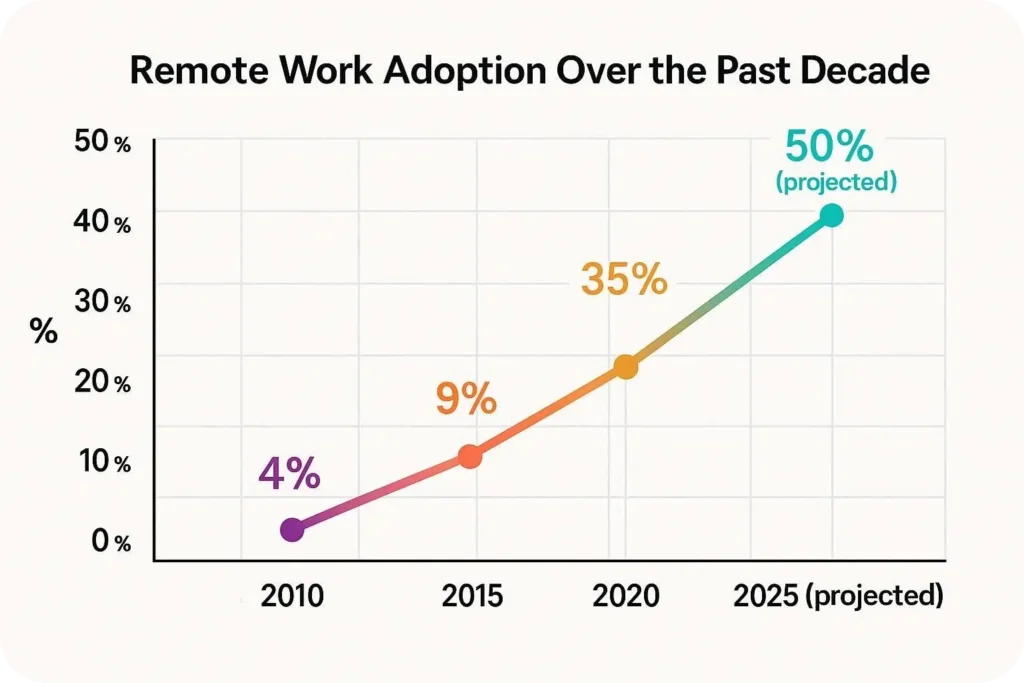
The remote machine learning revolution caught many by surprise. Few years ago, most AI teams insisted on in-person collaboration. Today? I’m seeing senior engineers manage entire data pipelines from home offices, coworking spaces, or wherever they choose to work.
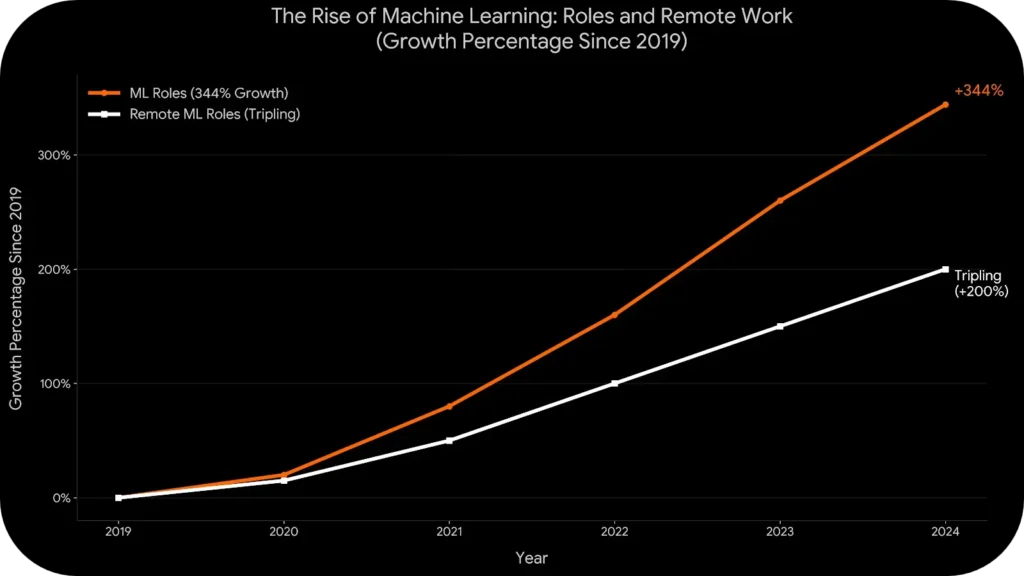
The numbers tell a compelling story. Machine learning engineer roles grew by 344% between 2019 and 2024 according to McKinsey’s AI Workforce Report. Remote positions within this field? They tripled in the same period. Companies discovered that talent matters more than location, especially when building intelligent systems that require specialized expertise.
Work-life balance became non-negotiable for many professionals. Commuting two hours daily to sit in an office and code? That’s outdated thinking. Remote work lets you structure your day around peak productivity hours, family commitments, and personal wellness.
The technology itself supports remote work beautifully. Cloud computing platforms like AWS, Azure, and Google Cloud let you access massive computational resources from anywhere. Your laptop becomes a portal to powerful servers that train complex neural networks.
Key Trends Driving Remote ML Opportunities
Generative AI changed everything. Tools like ChatGPT and Midjourney proved that machine learning models could create, not just analyze. Every company now wants their own AI capabilities. They need professionals who understand MLLM (Multimodal Large Language Models) and can build applications that generate text, images, code, and more.
The democratization of machine learning frameworks lowered barriers to entry. Libraries like TensorFlow, PyTorch, and scikit-learn handle the heavy lifting. This shift means companies need more machine learning engineers to deploy and customize these tools for specific business problems.
Industries beyond tech embraced AI. Healthcare uses machine learning for diagnostic predictions and drug discovery. Finance relies on AI decisioning for fraud detection and risk assessment. Manufacturing deploys predictive analytics to prevent equipment failures. Each sector needs domain experts who understand both the technology and the industry.
Top Remote Machine Learning Roles and Their Demands:

The Core: Remote Machine Learning Engineer
Machine learning engineers build and deploy AI systems that solve real business problems. Your daily work includes designing algorithms, preprocessing training datasets, selecting appropriate models, and optimizing performance. You’ll write production code that handles real-time data, scales to millions of users, and maintains accuracy over time.
Technical requirements start with Python, the language that dominates machine learning. You need fluency in TensorFlow or PyTorch for building deep learning models. Understanding Docker and Kubernetes helps you containerize applications and manage deployments.
Remote machine learning engineers must communicate clearly. You’ll write documentation, present findings to non-technical stakeholders, and collaborate with product managers, and front end developers.
Salary expectations range from $120,000 to $220,000 for mid-level positions. Senior engineers at top companies or those with specialized expertise in computer vision or natural language processing can earn upto $400,000+.
Building the Infrastructure: Remote ML Platform Engineer
ML platform engineers create the infrastructure that supports model development and deployment. You’ll build data pipelines that collect, clean, and transform information from multiple sources. These pipelines must handle massive scale – billions of data points processed daily.
Your work includes setting up training infrastructure, managing compute resources, and optimizing costs. You implement MLOps practices that automate testing, deployment, and monitoring.
Salaries for ML platform engineers range from ~$130,000 to $250,000. The role combines DevOps, data engineering, and machine learning knowledge – a rare combination that commands premium compensation.
The Innovators: Remote ML Research Scientist
Research scientists push the boundaries of what’s possible with artificial intelligence. Your work involves reproducing results from recent publications, adapting SOTA models (state-of-the-art) to new problems, and potentially contributing original research.
Many research scientists hold PhDs, though exceptional engineers with strong publication records can break in. You need deep understanding of deep learning theory, familiarity with optimization techniques, and the patience to run hundreds of experiments.
Compensation varies widely. University positions pay ~$80,000-$150,000. Industry research scientists at top companies earn ~$200,000-$450,000+.

Strategic Skill Development Roadmaps for Remote ML Success:
Foundational Skills: The Non-Negotiables
Breaking into remote machine learning jobs requires mastering core competencies. Python forms your foundation. You need more than basic syntax—understand object-oriented programming, functional concepts, and common design patterns.
Mathematics matters more than many realize. Linear algebra helps you understand how neural networks transform data through matrix operations. Probability and statistics let you evaluate model performance and understand uncertainty.
Master at least one machine learning framework deeply. TensorFlow and PyTorch dominate the field. Pick one, build projects, understand its quirks.
Version control through Git is mandatory. Know how to branch, merge, resolve conflicts, and use pull requests effectively. Contributing to open source projects builds this skill while demonstrating your abilities to employers.
Advanced & In-Demand Skills
Deep learning expertise opens doors to the most exciting projects. Understand convolutional neural networks for computer vision, recurrent networks for sequence data, and transformers for natural language processing. Build projects that demonstrate your abilities.
Transfer learning accelerates development by adapting pre-trained models to new tasks. This approach dominates modern machine learning practice.
Cloud computing platforms host most production systems. Gain hands-on experience with AWS SageMaker, Google Cloud AI Platform, or Azure Machine Learning.
Continuous Learning and Staying Current
Machine learning evolves rapidly. Read research papers regularly. arXiv publishes cutting-edge work daily. This habit keeps you aware of emerging trends.
Online courses provide structured learning paths. Contribute to open source projects related to machine learning. This builds your portfolio, teaches collaborative development, and connects you with other professionals.
Finding and Landing Your Dream Remote ML Job:
Where to Search for Remote ML Opportunities
We may be biased but signing up for FREE Remote Jobs Central Newsletter can be your BEST CHOICE (where we send you curated worldwide remote ML jobs). Of course, you don’t have to take our word for granted – Please see our reviews.
Networking beats cold applications consistently. Attend virtual meetups, engage in online communities, and reach out to professionals working where you want to work.
Crafting a Standout Remote ML Application
Your resume should lead with impact, not responsibilities. Don’t write “Built machine learning models.” Write “Reduced customer churn 23% by deploying gradient boosting classifier that predicts at-risk users.” Quantify everything possible.
Portfolio projects matter more than credentials. Build public repositories on GitHub showcasing your best work. Include thorough documentation, clear code, and compelling results.
Tailor each application to the specific role. Reference the company’s products, challenges, or recent news. Hiring managers notice when someone actually read the job descriptions.
Acing the Remote ML Interview Process
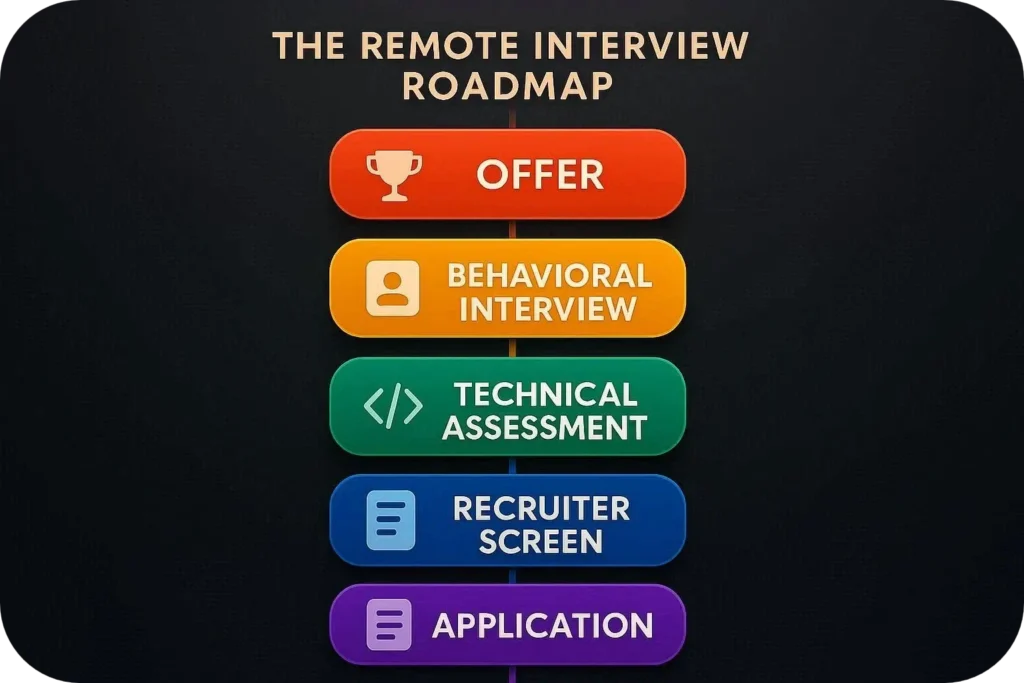
Remote machine learning interviews follow predictable patterns. Expect multiple rounds – usually four to six conversations. Initial screens focus on background and communication. Technical rounds assess coding, algorithms, and ML knowledge.
Coding interviews test data structures and problem-solving. ML-specific questions probe your understanding of model training, evaluation, and deployment. Expect questions like: “How would you handle imbalanced classes?” “Explain overfitting and how to prevent it.”
System design rounds ask you to architect complete solutions. These conversations assess your ability to think at scale.
Remote ML Compensation and Negotiation Strategies
Research salary expectations thoroughly before interviews. Glassdoor provides transparent compensation data. Understand what someone with your experience and skills should earn.
High-paying ML roles typically require specialized expertise. Computer vision, natural language processing, and generative AI specialists command premiums.
Some positions genuinely pay $400,000+ annually. These typically combine senior experience, specialized skills, and employment at well-funded companies. Realistic expectations for most professionals range from $120,000 to $250,000.
When negotiating, focus on total compensation, not just salary. Remote roles often include equity, bonuses, professional development budgets, and flexible schedules.
Thriving in a Remote Machine Learning Environment:

Mastering Remote Collaboration and Communication
Working remotely on machine learning projects requires different collaboration approaches than traditional office settings.
Overcommunicate intentionally. Remote work requires explicitly sharing context, progress, and blockers. Write detailed updates, document decisions, and keep stakeholders informed.
Collaborative tools form your communication backbone. Master Slack or Microsoft Teams for quick conversations. Use Zoom for face-to-face discussions.
Documentation becomes critical. Write clear READMEs for your code repositories. Document model architectures, experiment results, and deployment procedures.
Managing Your Time and Productivity
Create dedicated workspace. Working from bed destroys productivity. Set up a proper desk with good lighting, comfortable seating, and minimal distractions.
Establish consistent routines. Start work at the same time daily. Take regular breaks. End your day definitively rather than letting work bleed into evening indefinitely.
Protect your calendar. Block focus time for deep work. Guard your most productive hours ruthlessly.
Set boundaries between work and personal life. Remote work’s flexibility can become all-consuming. Define working hours and protect personal time.
Technical Aspects of Remote ML Work
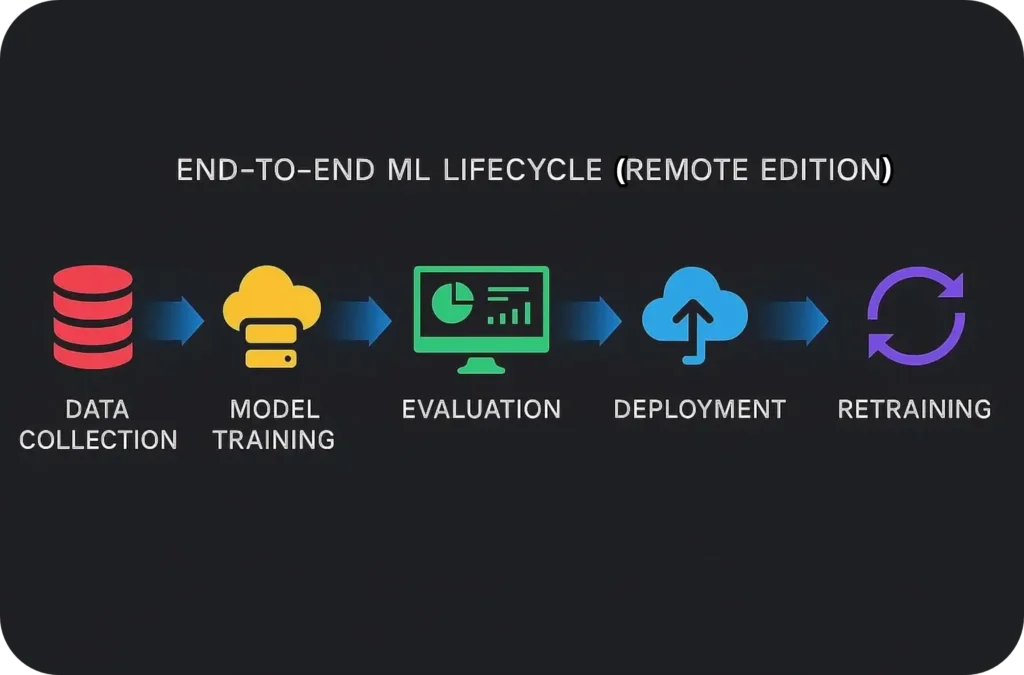
Cloud computing enables remote model training at scale. You’ll provision GPU instances, upload training datasets, and monitor runs remotely. Understanding cost optimization prevents shocking bills.
Data pipelines must be robust and monitored. Set up monitoring for data quality, pipeline failures, and drift.
Security becomes paramount handling sensitive data remotely. Use VPNs, encrypt data at rest and in transit, and follow company security protocols religiously.
Industry-Specific Remote ML Opportunities:

Healthcare & Biostatistics
Healthcare offers some of the most impactful machine learning applications. Diagnostic models save lives. Drug discovery algorithms accelerate research.
Biostatistics specialists analyze clinical trial data, build survival models, and evaluate treatment effectiveness. Remote positions exist at pharmaceutical companies, research institutions, and health tech startups.
Medical imaging uses computer vision to detect diseases from X-rays, MRIs, and CT scans. You’ll build models that identify tumors and assist radiologists.
Salaries in healthcare ML range from $110,000 to $200,000+.
Finance & AI Decisioning
Fraud detection systems analyze transaction patterns to identify suspicious activity. You’ll build models processing real-time data, flagging potential fraud within milliseconds.
Algorithmic trading uses predictive analytics to identify profitable opportunities. These roles often pay $200,000-$400,000+ but demand intense pressure.
Credit risk assessment determines who receives loans and at what rates. Your models predict default probability based on financial history and hundreds of other factors.
Manufacturing & Supply Chain
Predictive maintenance anticipates equipment failures before they occur. You’ll analyze sensor data from factory machinery, building models that predict when components need replacement.
Supply chain optimization uses ML to forecast demand, optimize inventory, and streamline logistics. Your models might determine optimal stock levels or predict shipping delays.
Robotic industry applications include path planning and object recognition.
Autonomous Vehicles
Self-driving car development requires computer vision for object detection and planning algorithms that make split-second decisions. Companies like Waymo, Cruise, and Tesla hire ML specialists.
AV training involves creating simulation environments, labeling training data, and testing models across countless scenarios.
Remote positions exist primarily in model development, data analysis, and simulation.
Future Outlook:
The Evolution of Remote ML Careers
The Continued Impact of Generative AI and MLLM
Generative AI changed public perception of artificial intelligence overnight. This shift created unprecedented demand. Every company now wants generative capabilities.
Multi-modality model development combines text, images, audio, and video understanding. Specialists who understand multiple data types will command premium positions.
The Growing Demand for Model Robustness Evaluations
Model robustness evaluations ensure systems work reliably across diverse conditions. You test against adversarial examples, distribution shifts, and edge cases.
Red teaming for AI systems – intentionally trying to break models – becomes a distinct career path. Companies hire specialists to probe weaknesses before deployment.
AI Workflow Automation
AI workflow automation represents the next productivity frontier. AutoML platforms automatically select models, engineer features, and optimize hyperparameters.
Data labeling automation uses active learning to minimize human annotation requirements. This approach reduces labeling costs by 10x or more.
Continuous training pipelines automatically retrain models as new data arrives. Your systems detect drift, trigger retraining when necessary, and deploy updated models without manual intervention.
Conclusion:
Your Path to a Successful Remote ML Career
The journey to landing remote machine learning jobs combines technical mastery, strategic positioning, and persistent effort. You’ve seen the landscape – from fundamental roles like machine learning engineer to specialized positions in healthcare, finance, and autonomous vehicles.
Your success depends on building solid foundations first. Master Python, understand algorithms, and gain hands-on experience with TensorFlow or PyTorch. Then layer on specializations that match your interests.
The remote aspect requires additional capabilities beyond technical skills. You must communicate clearly, work independently, and build trust across distances.
The compensation justifies the effort. Six-figure salaries, geographic flexibility, and meaningful work solving real problems – these are standard outcomes for skilled professionals in this field.
Ready to take the next step? Want exclusive access to the best remote ML job listings, including opportunities with many super cool companies that you may have never heard of (but YOU SHOULD)? Then, Sign up to our FREE Remote Jobs Central newsletter to get the latest remote job listings directly in your inbox and also Subscribe to our YouTube channel for awesome videos with research backed insights and expert tips.
What’s the biggest challenge you face in your remote Machine Learning Engineer job search? Have you ever applied for one online? Share your experience in the comments below – let’s build a community of remote ML professionals and support each other.
FAQ:
Are there Remote Machine Learning Jobs?
Yes, remote machine learning jobs are abundant and growing rapidly across the tech industry and beyond. Thousands of companies now hire machine learning engineers to work from anywhere, driven by global talent competition and proven remote work success offering competitive salaries typically ranging from $120,000 to $300,000+ annually depending on experience and specialization.
What Tech Jobs Pay $400,000 a Year?
Senior and staff-level machine learning engineers at top tech companies can earn $400,000+ through combined base salary, equity, and bonuses. Specialized roles in algorithmic trading, autonomous vehicle development, and generative AI research at well-funded organizations reach this compensation level. Principal ML engineers, AI research scientists at companies like Google, Meta, and OpenAI, and ML leadership positions frequently exceed this threshold. However, reaching $400,000 typically requires 8-15 years of experience, specialized expertise, and employment at companies with substantial funding or revenue.
Can a Machine Learning Engineer Work Remotely?
Absolutely – machine learning engineers are ideally suited for remote work since the role centers on code development, model experimentation, and data analysis, all performable from anywhere with strong internet connectivity. Cloud computing platforms provide necessary computational resources remotely, collaboration tools enable effective team communication, and version control systems keep distributed teams synchronized. Most ML engineering tasks don’t require physical presence, making remote arrangements standard practice at forward-thinking companies.
Is ML a High Paying Job?
Yes, machine learning careers rank among tech’s highest-paying specializations, with median salaries for ML engineers around $150,000-$180,000 and experienced professionals earning $200,000-$300,000 or more. The combination of strong demand, limited talent supply, and high business impact drives premium compensation. Entry-level positions typically start at $100,000-$120,000, while senior specialists in hot areas like deep learning, computer vision, or natural language processing command substantial premiums.