Remote Marketing Jobs: 51 Rewarding Roles Offering Flexibility

Summary:
Remote marketing jobs offer flexible career opportunities across content creation, social media management, email campaigns, and paid advertising. This comprehensive guide equips you by revealing actionable strategies, help build essential skills, and succeed in the growing world of remote marketing careers. Whether you’re seeking entry-level positions or senior roles, you’ll discover proven methods to stand out.
Key Takeaways:
- Remote marketing jobs span 50+ roles including content marketing, SEO, social media management, email marketing, and paid advertising positions.
- Entry-level candidates can start with remote marketing positions by mastering free tools like Google Analytics, Canva, and getting HubSpot Academy certifications.
- Digital marketing professionals earn $50,000-$150,000+ annually depending on specialization, with marketing manager remote jobs commanding premium salaries.
- Success requires both technical skills (SEO, analytics, automation) and soft skills (communication, time management, self-discipline).
- Work from home marketing positions demand strong portfolios showcasing measurable results, not just task completion.
- Specialized niches like AI marketing, SaaS growth, and e-commerce offer higher compensation and job security.
- Remote marketers must proactively combat isolation through networking, regular communication, and setting boundaries.
Introduction:
The Rise of Remote Marketing and Your Flexible Future
Welcome to the Remote Revolution in Marketing
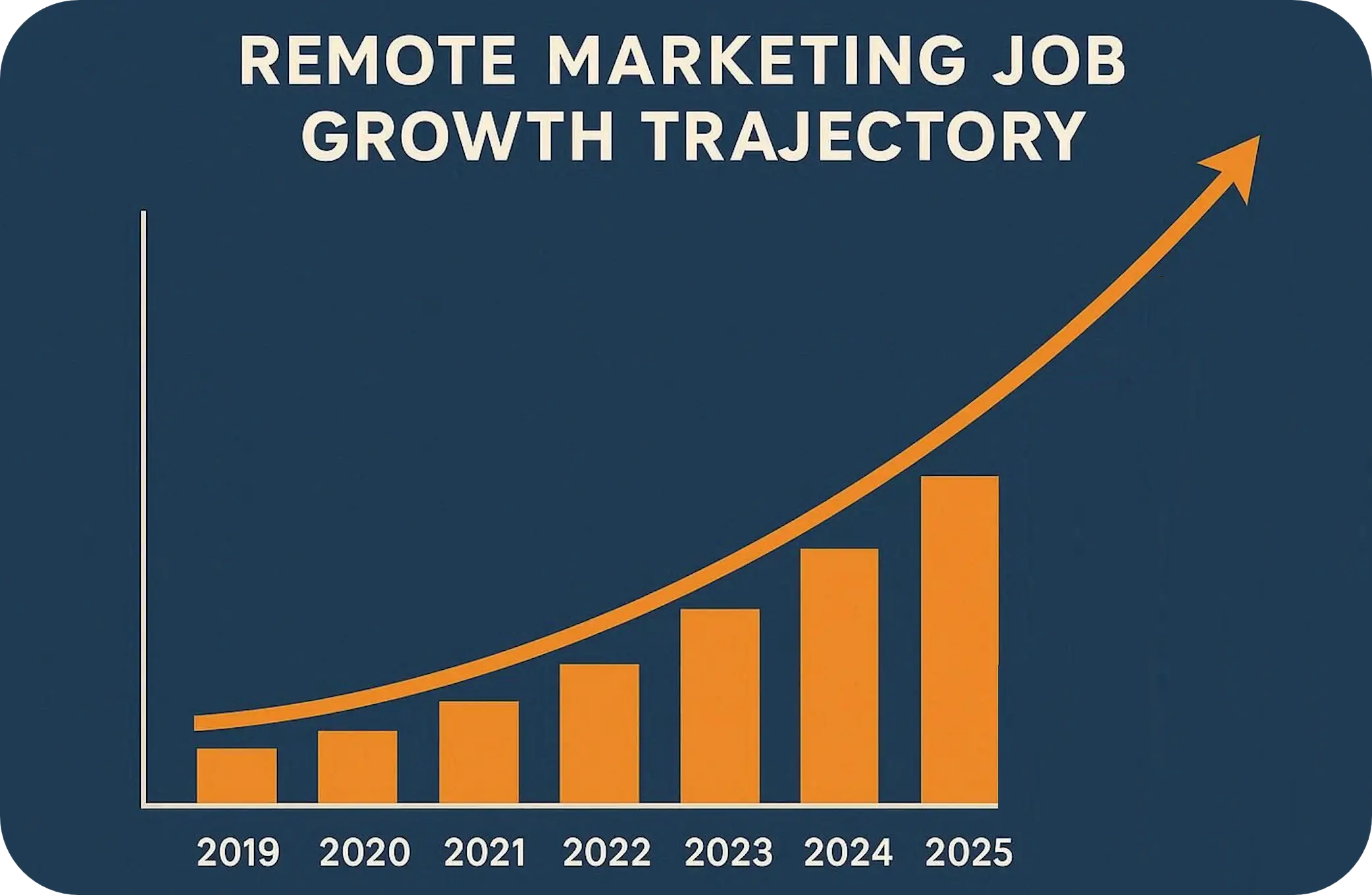
Remote marketing jobs have transformed from rare perks to mainstream career options. The shift happened fast. Between 2020 and 2024, companies realized that talented marketers don’t need cubicles to crush campaigns. They need Wi-Fi, creativity, and results-driven mindsets.
Here’s a surprising fact: remote marketers often outperform office-based teams. Why? Fewer interruptions. Better focus. And the ability to structure workdays around peak productivity hours rather than arbitrary 9-to-5 schedules.
Why a Flexible Career in Marketing is More Attainable Than Ever
The demand for online marketing jobs has exploded. According to Bureau of Labor Statistics data, over all employment of marketing managers is projected to grow 6 percent from 2024 to 2034.
Technology made this possible. Cloud-based tools like Slack, Asana, and Google Analytics mean your “office” fits in a laptop bag. You can manage campaigns from coffee shops, co-working spaces, or your kitchen table.
Companies now compete globally for talent. A startup in Austin can hire a brilliant content strategist from Africa, Asia or Australia. Geography no longer limits opportunity.
But here’s the reality check: remote positions attract massive applicant pools. You’re competing with candidates from everywhere. That’s why you need a smart strategy.
What This Guide Will Cover:
Your Roadmap to Remote Marketing Success
This guide shares everything like:
- The exact skills employers seek in remote candidates
- How to position yourself for entry level remote marketing jobs through advanced roles
- Which tools and certifications boost your credibility instantly
- Technique that convinces even the most skeptical hiring managers, that they found the best person for the job (in you)
- Productivity systems that help you thrive working from home
Whether you’re exploring marketing remote jobs for the first time or seeking senior leadership positions, this roadmap gives you an unfair advantage.
Understanding the Remote Marketing Landscape:
Defining Remote Marketing: Beyond Location, Embracing Flexibility
Remote marketing positions mean more than working from home. They represent a fundamental shift in how marketing teams operate.
Let me break down the spectrum:
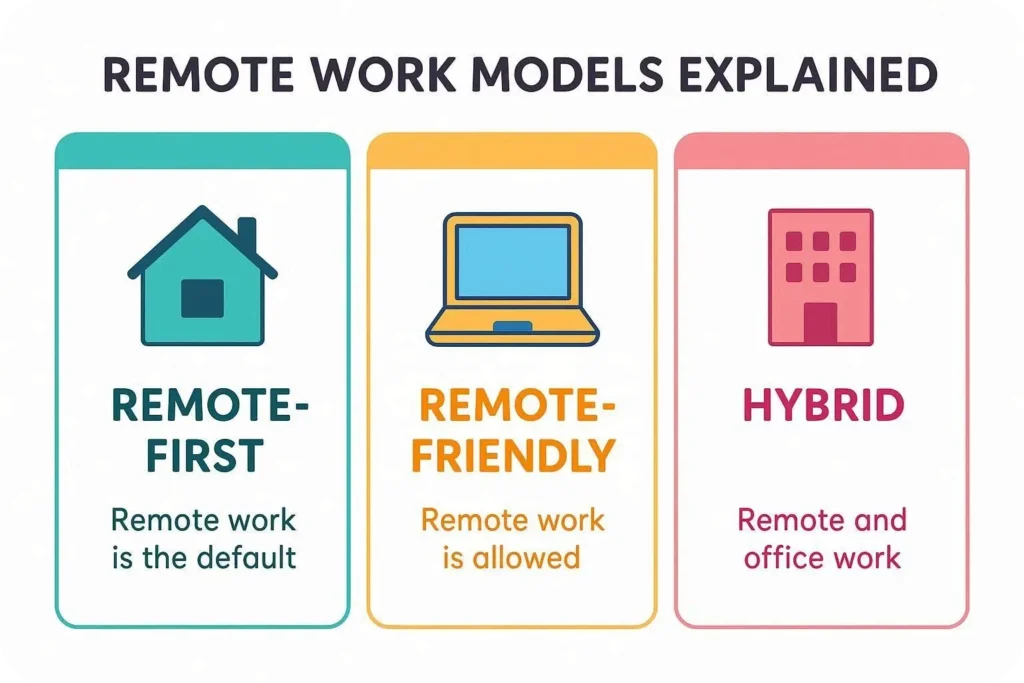
Fully Remote / Remote-First: Work from anywhere. No physical office exists. Team members scattered all around the world across different time zones. Communication happens async through Slack, email, and recorded video updates.
Remote Friendly: Company has an office, but culture prioritizes distributed work. In-person gatherings happen quarterly or annually. Daily operations assume everyone’s remote.
Hybrid Remote: Split time between home and office. Maybe you go in Tuesdays and Thursdays for team meetings. The rest happens wherever you’re productive.
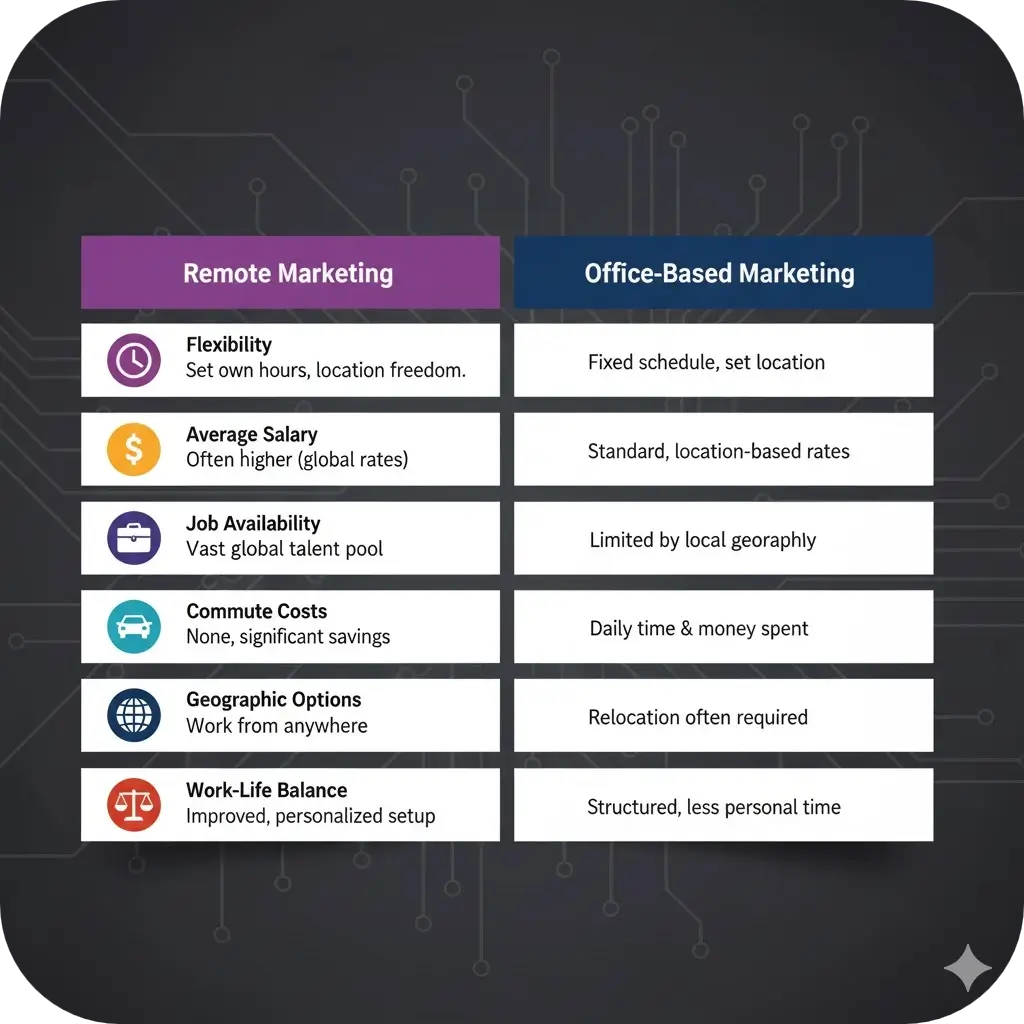
The flexibility extends beyond location. Many work from home marketing positions offer asynchronous schedules. Start at 6 AM or 10 PM – whatever fits your life. Employers care about results, not when and/or where you’re online.
Benefits of a Remote Marketing Career
Why do marketers (or in general remote workers) love remote work? Let me count the ways:
1) Time Reclaimed: Your most important precious commodity. Average one way commute time in the US (or hypothetically let’s say in general to any office based job around the world) is ~51 minutes daily.
If your one-way daily commute is 51 minutes, your round trip totals 1.7 hours each day you go to the office. Over a standard work year of 260 days (5 days a week for 52 weeks), this adds up to 442 hours annually spent commuting.
To put that into perspective, since a full-time job is typically 2,080 hours per year, you are spending your precious time equivalent of over 11 entire 40-hour workweeks each year – just traveling to and from your job. 😳 😱
2) Financial Savings: Save up to $5,000-$15,000 yearly on commuting, parking, work clothes, and daily coffee runs. One colleague calculated she saved $12,000 her first remote year.
3) Location Independence: Live in a low-cost city while earning Silicon Valley rates. Move near family without career sacrifice. Travel while working (digital nomad lifestyle).
4) Better Health: Skip rush hour stress. Cook nutritious meals at home. Fit in midday workouts.
5) Focus Time: Offices interrupt constantly – tap on the shoulder, impromptu meetings, loud colleagues. Home offices let you enter deep work states crucial for strategy and creative tasks.
6) Career Opportunities: Access positions unavailable locally. Apply to super cool remote jobs from amazing forward-thinking companies who think geography doesn’t matter and accept you from wherever you are.
But I won’t sugarcoat it – challenges exist too and it’s not as easy as it sounds.
Challenges of Remote Marketing and How to Overcome Them
Isolation and Loneliness: Working alone daily can feel draining. Solution? Schedule virtual coffee chats with teammates. Join co-working spaces twice weekly.
Communication Gaps: Misunderstandings happen easier over Slack. Tone gets lost in text. Solution? Over-communicate. Use video for complex topics. Confirm understanding by summarizing decisions in writing.
Work-Life Boundaries: Your bedroom becomes your office. It’s 8 PM and you’re still answering emails. Solution? Set strict hours. Create physical workspace separation. Use separate work and personal devices.
Visibility Concerns: Out of sight, out of mind? Remote workers worry they’ll get passed over for promotions. Solution? Share progress updates weekly. Celebrate wins publicly in team channels. Request regular 1-on-1s with managers.
Distractions at Home: Kids, pets, deliveries, household tasks compete for attention. Solution? Communicate your schedule to family. Use noise-canceling headphones. Block focus time on your calendar.
Technology Issues: Unreliable internet kills productivity. Solution? Invest in solid internet connection. Have a mobile hot spot ready. Identify backup work locations nearby.
Essential Skills for Remote Marketers

Landing digital marketing remote jobs requires a specific skill stack. Let me break it down:
Analytical Skills: Data drives modern marketing decisions. You must interpret Google Analytics dashboards, calculate ROI, identify trends in campaign performance, and make evidence-based recommendations.
Start here:
- Master Google Analytics 4
- Learn basic Excel functions (VLOOKUP, pivot tables, charts)
- Understand attribution modeling
- Practice A/B test analysis
SEO Knowledge: Organic traffic fuels business growth. Remote marketers need keyword research skills, on-page optimization understanding, technical SEO basics, and content strategy abilities.
PPC Expertise: Paid advertising generates immediate results. Learn Google Ads mechanics, Facebook Ads Manager, campaign structure, bidding strategies, and conversion tracking.
Creative Storytelling: Numbers matter, but stories convert. You need compelling copy writing skills, brand voice consistency, emotional resonance understanding, and audience psychology knowledge.
Technical Proficiency: Modern marketers are part technologist. You’ll work with:
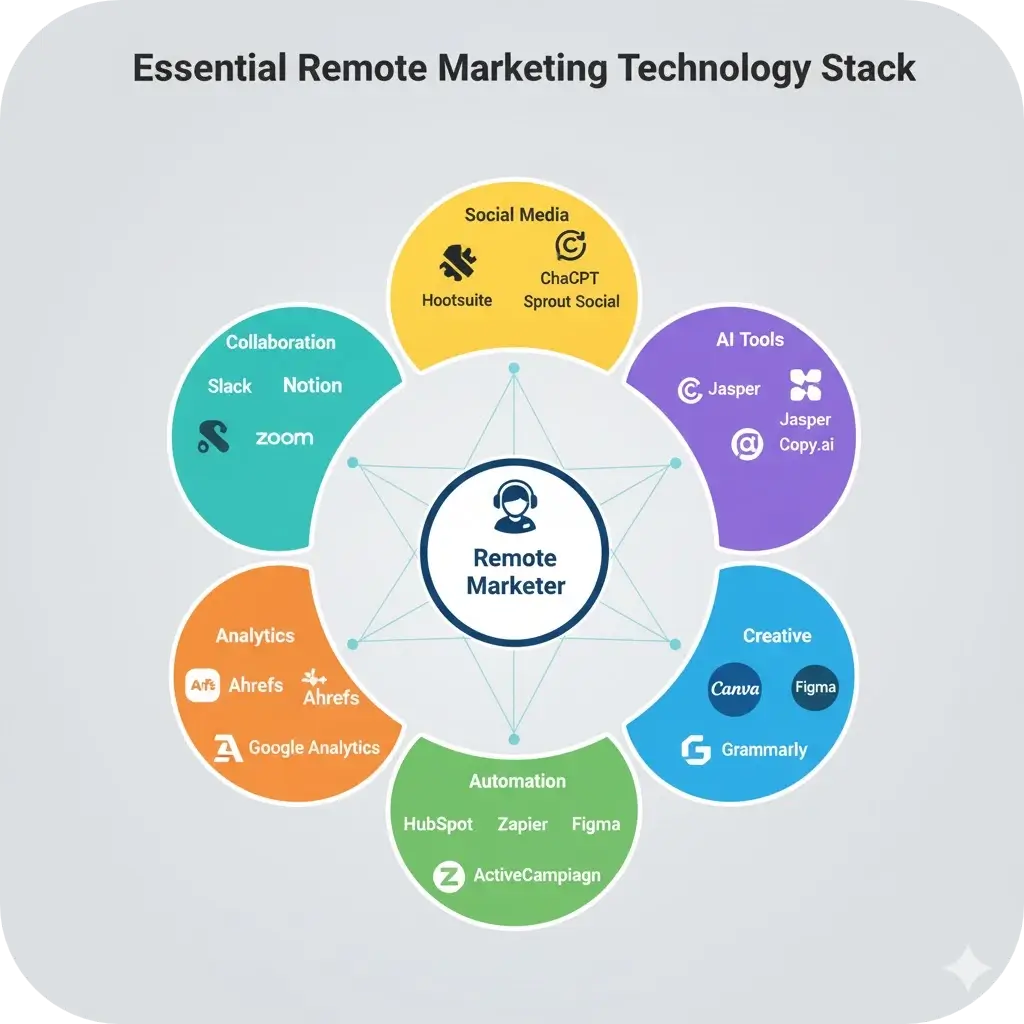
- Marketing automation platforms (HubSpot, Marketo, ActiveCampaign)
- CRM systems (Salesforce, Pipedrive)
- AI tools (ChatGPT, Jasper, Copy.ai)
- Design software (Canva, Figma)
- Project management tools (Asana, Trello, Monday.com)
Video Creation: Video dominates social media and content strategies. Learn basic editing (CapCut, Premiere Rush), on-camera presence, script writing, and platform optimization (YouTube, TikTok, Instagram Reels).
Soft Skills (Often Overlooked):
- Clear Communication: Write concise emails. Ask clarifying questions. Summarize meeting outcomes.
- Time Management: Prioritize ruthlessly. Use time-blocking. Say no to low-value tasks.
- Self-Direction: You won’t have a boss watching. Set goals independently. Hold yourself accountable.
- Collaboration Across Time Zones: Respect different schedules. Document decisions. Use async communication effectively.
These soft skills separate good remote marketers from great ones. Technical abilities get you interviews. Soft skills get you hired and promoted.
Navigating In-Demand Remote Marketing Roles and Niches:
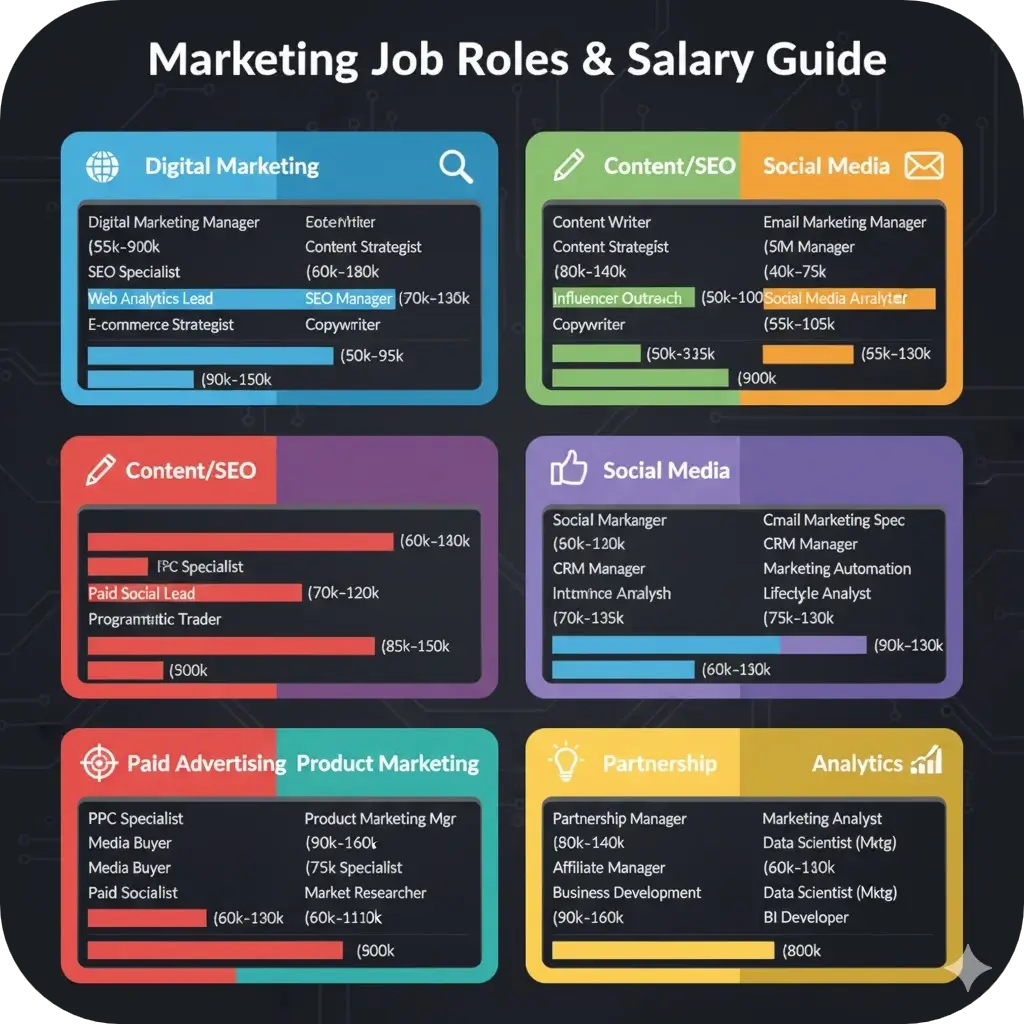
The marketing field contains 50+ distinct roles. Understanding this landscape helps you identify where your strengths fit and where opportunities hide.
Core Digital & General Marketing Roles
These positions oversee multiple channels or broad marketing functions. They’re perfect for strategic thinkers who enjoy variety.
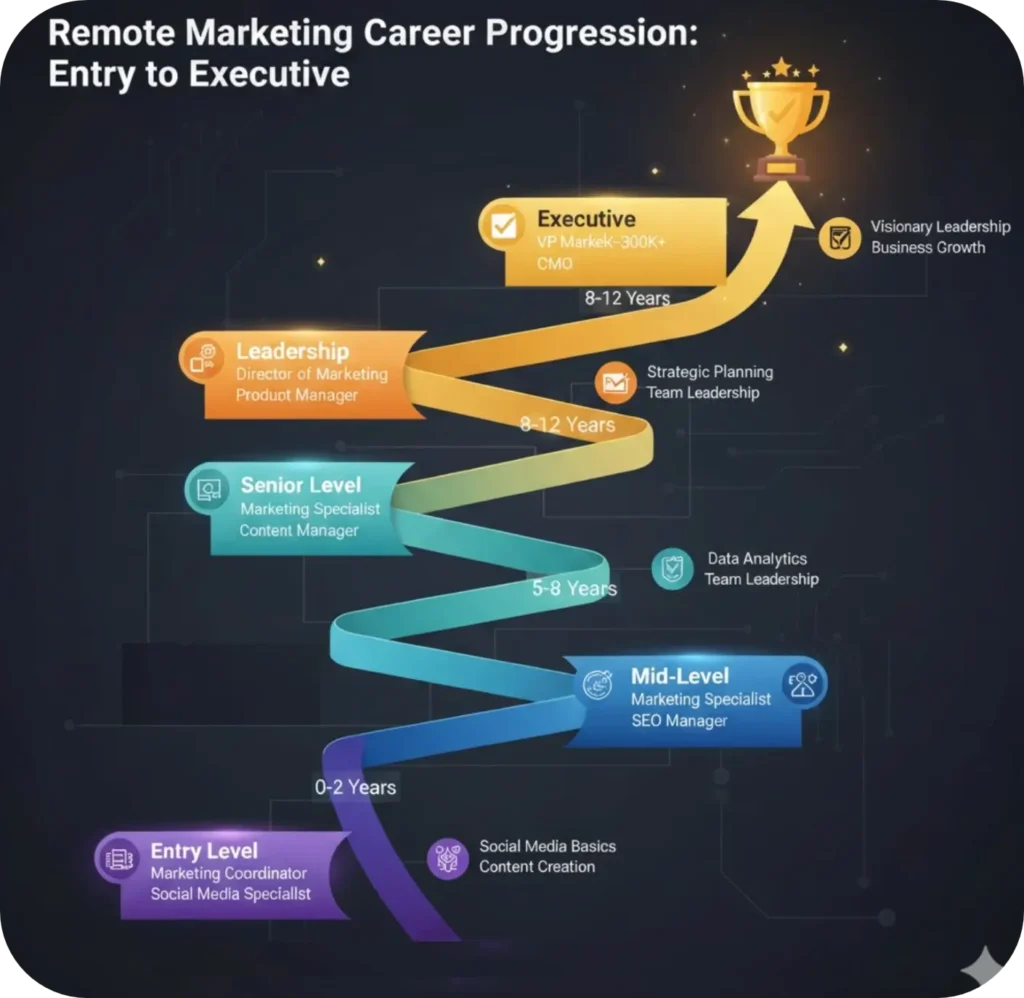
Remote Digital Marketing Jobs: Generalist roles managing SEO, content, social media, email, and paid ads. Entry-level positions start around $45,000-$60,000. Experienced professionals earn $75,000-$100,000+.
Remote Marketing Manager Jobs: Coordinate campaigns, manage budgets, lead team members, and report to executives. These positions require 3-5 years experience and pay $70,000-$110,000.
Remote Marketing Coordinator Jobs: Entry-level roles supporting marketing initiatives. You’ll schedule social posts, update websites, coordinate events, and assist senior marketers. Salaries range $40,000-$55,000.
Remote Marketing Specialist Jobs: Focus on specific functions like lifecycle marketing, customer acquisition, or product launches. Mid-level positions earning $60,000-$85,000.
Remote Growth Marketing Jobs: High-demand roles focused on rapid customer acquisition and retention through experimentation. Growth marketers test relentlessly, analyze ruthlessly, and scale what works. Compensation: $80,000-$140,000.
Remote Demand Generation Jobs: B2B-focused roles filling sales pipelines with qualified leads. You’ll manage webinars, gated content, nurture campaigns, and lead scoring. Pay range: $75,000-$120,000.
Remote Director of Marketing Jobs: Lead entire marketing departments. Set strategy, manage substantial budgets, hire team members, and align marketing with business objectives. Salaries: $100,000-$180,000+.
Remote CMO Jobs: Executive leadership roles shaping company-wide marketing vision. These positions require 10+ years experience and offer $150,000-$300,000+ compensation.
Content, Copywriting & SEO Marketing Roles
If you love words and organic growth, these specializations offer fulfilling career paths.
Remote Content Marketing Jobs: Create blog posts, e-books, case studies, whitepapers, and video scripts that attract and educate audiences. Entry-level: $45,000-$65,000. Experienced: $70,000-$95,000.
Remote SEO Copywriter Jobs: Combine persuasive writing with search optimization. You’ll research keywords, craft compelling headlines, and structure content for rankings and conversions. Pay: $60,000-$90,000.
Remote SEO Marketing Jobs: Drive organic traffic through keyword strategy, technical optimization, link building, and content planning. Junior SEOs earn $50,000-$70,000. Senior specialists command $85,000-$130,000.
Remote SEO Specialist Jobs: Focus on specific SEO aspects like technical audits, local optimization, or enterprise SEO. Mid-level positions earning $70,000-$105,000.
Remote Content Strategist Jobs: Plan content calendars, define brand voice, guide editorial direction, and measure content performance. These roles require strategic thinking and pay $75,000-$115,000.
Remote Video Content Producer Jobs: Script, film, edit, and optimize video content. Video skills are incredibly valuable and relatively rare. Salaries: $60,000-$100,000.
Social Media, Community & PR Marketing Roles
Perfect for relationship-builders who understand human psychology and cultural trends.
Remote Social Media Marketing Jobs: Manage brand presence across platforms. Create posts, engage audiences, analyze metrics, and stay current with platform changes. Entry-level: $40,000-$60,000. Experienced: $65,000-$90,000.
Remote Social Media Manager Jobs: Lead social strategy, manage content calendars, oversee paid social campaigns, and guide brand voice. Mid-senior positions earning $60,000-$95,000.
Remote Community Manager Jobs: Build and nurture online communities. Moderate discussions, organize virtual events, resolve conflicts, and turn members into advocates. Pay range: $50,000-$80,000.
Remote Influencer Marketing Jobs: Identify relevant influencers, negotiate partnerships, manage campaigns, and track ROI. This growing field pays $55,000-$95,000.
Remote Public Relations Jobs: Manage media relationships, write press releases, handle crisis communications, and build brand reputation. PR specialists earn $55,000-$90,000.
Remote Brand Marketing Jobs: Shape brand identity, ensure consistency across touch points, and build emotional connections with audiences. Brand marketers earn $70,000-$110,000.
Email, CRM & Lifecycle Marketing Roles
These data-driven roles focus on customer retention and automated communication.
Remote Email Marketing Jobs: Design email campaigns, segment audiences, optimize deliverability, and improve open and click rates. Email marketers earn $50,000-$85,000. Email marketing generates $42 for every $1 spent – the highest ROI of any marketing channel. That’s why these roles remain in high demand.
Remote Lifecycle Marketing Jobs: Guide customers through awareness, consideration, purchase, retention, and advocacy stages. You’ll create automated journeys that nurture relationships over time. Salaries: $70,000-$105,000.
Remote Marketing Automation Jobs: Build sophisticated workflows in platforms like HubSpot, Marketo, or Pardot. Technical marketers who understand automation command $75,000-$115,000.
Remote CRM Marketing Jobs: Manage customer relationship management systems, ensure data quality, create segmentation strategies, and enable sales teams. CRM specialists earn $65,000-$100,000.
Remote HubSpot Specialist Jobs: Master HubSpot’s marketing, sales, and service hubs. Certified HubSpot experts are highly sought after. Pay: $60,000-$95,000.
Paid, Search & Conversion Marketing Roles
Numbers-obsessed marketers thrive in these performance-focused positions.
Remote PPC Marketing Jobs: Manage pay-per-click campaigns across Google Ads, Facebook Ads, Microsoft Ads, and other social platforms. PPC specialists earn $55,000-$95,000.
Remote Google Ads Specialist Jobs: Focus exclusively on Google’s advertising ecosystem including Search, Display, Shopping, and YouTube ads. Specialists command $60,000-$100,000.
Remote Facebook Ads Manager Jobs: Run campaigns on Facebook and Instagram. Understand audience targeting, creative testing, and Meta’s ever-changing algorithm. Salaries: $55,000-$90,000.
Remote Conversion Rate Optimization Jobs: Improve website conversion through testing, user research, and experience optimization. CRO specialists earn $70,000-$110,000.
Remote E-commerce Marketing Jobs: Drive online sales for retail brands. Manage product feeds, optimize listings, coordinate promotions, and analyze shopping behavior. Pay range: $60,000-$100,000.
Remote Performance Marketing Jobs: Accountable for measurable results like leads, sales, or revenue. Performance marketers typically earn $75,000-$120,000 plus bonuses tied to results.
Product, Brand & Go-to-Market Marketing Roles
These strategic positions bridge product development, sales, and customer understanding.
Remote Product Marketing Jobs: Position products effectively, create messaging, enable sales teams, and launch new offerings. Product marketers earn $80,000-$130,000.
Remote Product Marketing Manager Jobs: Lead product launches, conduct competitive analysis, develop positioning frameworks, and create sales collateral. Senior PMMs command $95,000-$150,000.
Remote Go-to-Market Marketing Jobs: Plan and execute strategies for bringing products to market. GTM roles require cross-functional leadership and pay $85,000-$135,000.
Remote Brand Strategist Jobs: Define brand positioning, develop messaging architectures, and guide creative direction. Brand strategists earn $75,000-$120,000.
Partnership, Affiliate & Specialized Marketing Roles
Relationship-driven marketers excel in these collaborative positions.
Remote Affiliate Marketing Jobs: Build and manage partnerships where others promote your products for commission. Affiliate managers earn $60,000-$95,000.
Remote Partnership Marketing Jobs: Develop strategic alliances that benefit both companies. Create co-marketing campaigns, coordinate joint ventures, and track partnership ROI. Salaries: $70,000-$110,000.
Remote Account-Based Marketing Jobs: Target specific high-value accounts with personalized campaigns. ABM specialists command $75,000-$115,000 in B2B sectors.
Analytics, Data & Research Marketing Roles
Data-driven decision makers thrive in these insight-focused positions.
Remote Marketing Analytics Jobs: Transform data into actionable insights. Build dashboards, identify trends, forecast performance, and recommend optimizations. Analysts earn $65,000-$105,000.
Remote Market Research Jobs: Conduct surveys, analyze customer behavior, identify market opportunities, and inform strategy. Researchers command $60,000-$95,000.
Remote Marketing Data Analyst Jobs: Focus on statistical analysis, modeling, and predictive analytics. Data-focused roles pay $70,000-$110,000.
Core Remote Marketing Functions and Their Flexibility
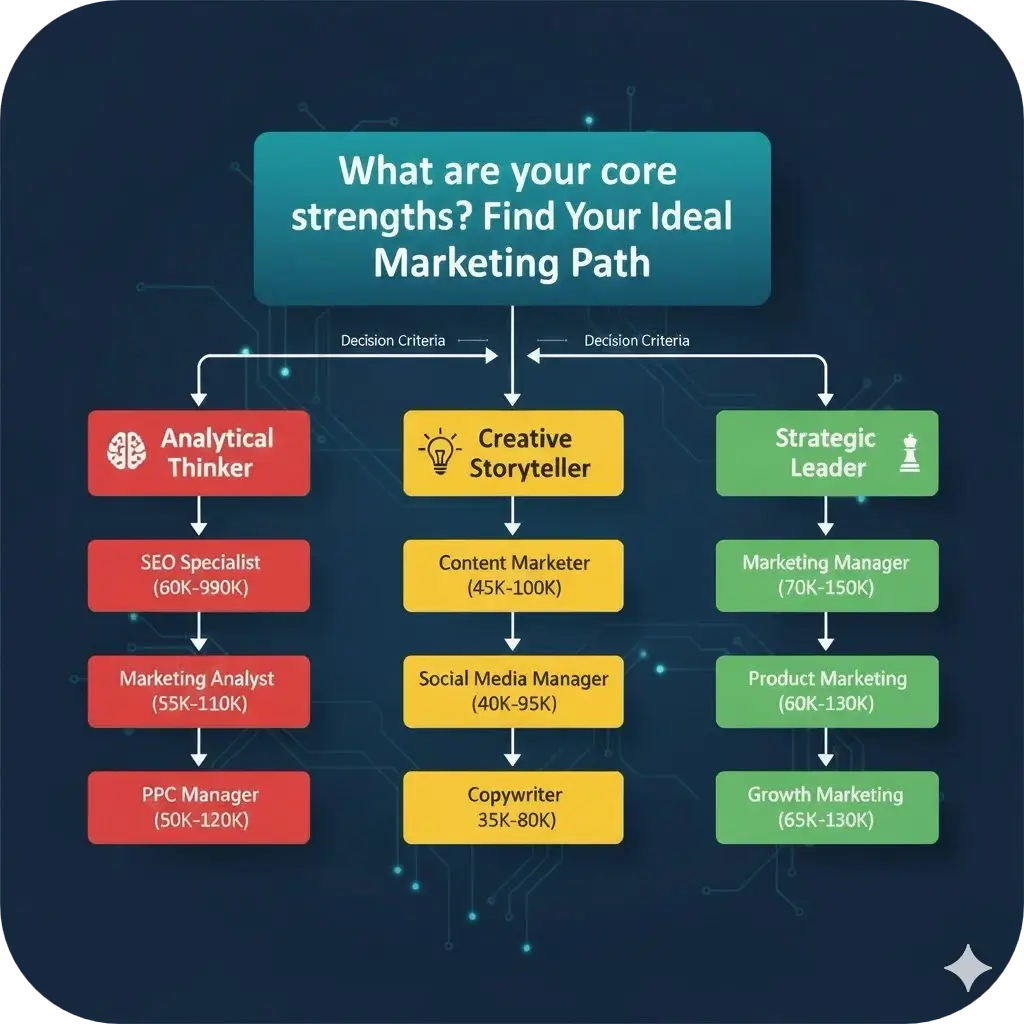
Each role offers different flexibility levels. Content creators often enjoy complete schedule autonomy – write whenever inspiration strikes. PPC managers need real-time monitoring during business hours. Social media specialists must post when audiences are active.
Community managers require consistent presence. Brand strategists work project-based with flexible timing. Email marketers can batch work and schedule sends.
Consider your ideal lifestyle when choosing specializations. Early bird? Focus on roles with flexible schedules. Night owl? Same. Need structured hours? Client-facing positions provide routine.
Emerging and Specialized Remote Marketing Fields
These cutting-edge areas offer explosive growth potential:
Remote AI Marketing Jobs: Use artificial intelligence tools to scale content creation, personalize experiences, and automate tasks. AI marketers earn $80,000-$140,000. ChatGPT, Midjourney, and similar tools are transforming marketing. Early adopters gain massive advantages.
Remote SaaS Marketing Jobs: Market software-as-a-service products using product-led growth strategies. SaaS marketers command $75,000-$130,000.
Remote Video Marketing Jobs: Create video strategies spanning YouTube, TikTok, Instagram Reels, and LinkedIn video. Video specialists earn $65,000-$105,000.
Remote Podcast Marketing Jobs: Produce, promote, and monetize podcast content. This emerging field pays $55,000-$90,000.
Remote CRM Manager Jobs: Oversee customer relationship management strategy and execution. CRM managers earn $70,000-$110,000.
Remote MarTech Manager Jobs: Manage marketing technology stacks. Evaluate tools, integrate systems, train teams, and optimize workflows. MarTech managers command $80,000-$125,000.
The marketing landscape constantly shifts. Stay curious, keep learning, and adapt quickly.
Essential Skills & Tools for Remote Marketing Professionals:
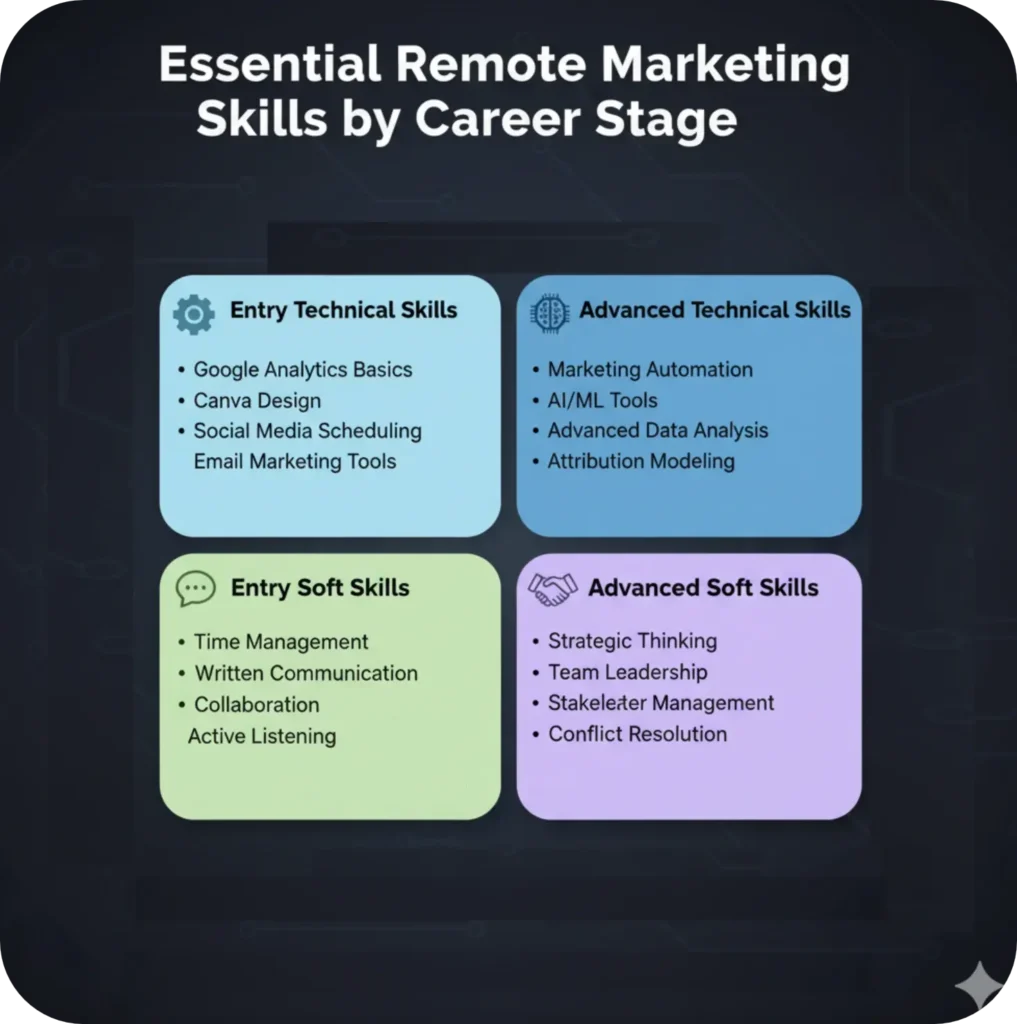
Success in remote marketing positions requires mastering both foundational skills and modern tools.
Core Digital Marketing Skills to Master
Search Engine Optimization: Understanding how search engines rank content is non-negotiable. Study keyword research methodologies, on-page optimization factors, technical SEO requirements, and link building strategies.
Content Creation: Whether writing blog posts, filming videos, designing graphics, or recording podcasts – you must create compelling content. Practice daily. Study successful examples. Develop your unique voice.
Data Analysis: Marketing without analytics is guessing. Learn to read Google Analytics reports, calculate conversion rates, identify statistical significance, and make data-informed recommendations.
Customer Psychology: Why do people buy? What objections prevent purchases? How do emotions influence decisions? Understanding human behavior makes you 10x more effective.
Paid Advertising: Master at least one paid channel deeply. Google Ads and Facebook Ads offer free certification courses. Start there.
Email Marketing: Despite predictions of its death, email remains incredibly effective. Learn list segmentation, subject line optimization, deliverability best practices, and automation workflows.
Social Media Strategy: Each platform has unique algorithms, audiences, and content formats. Choose 2-3 to master rather than spreading yourself thin.
Remote Work Productivity Skills
Technical marketing skills get you hired. Productivity skills keep you employed and promoted.
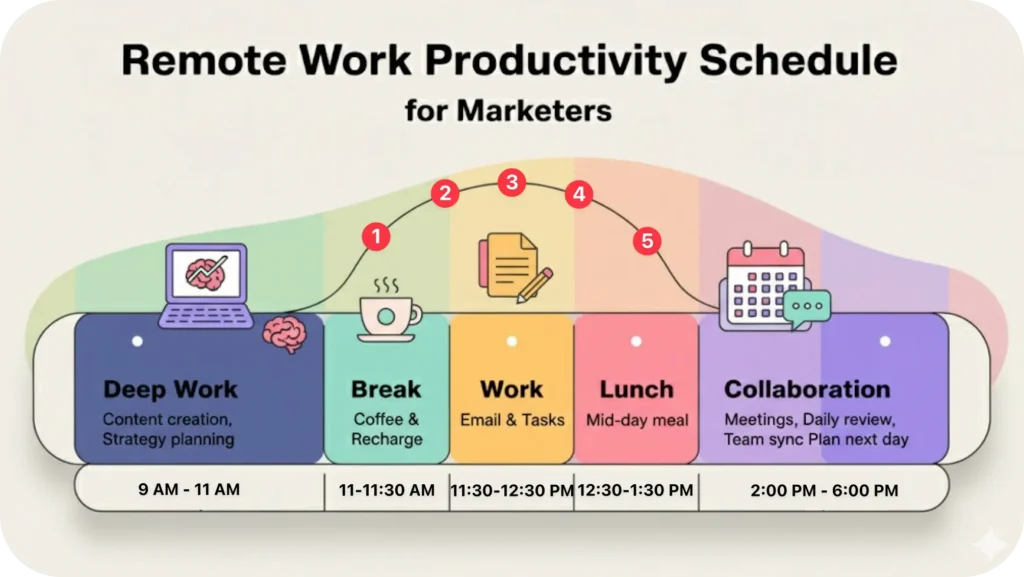
Time Management: Working from home requires discipline. I use time-blocking – assigning specific hours to specific tasks. Deep work happens mornings. Meetings happen afternoons. Admin tasks fill gaps.
Async Communication: Remote teams often work across time zones. Master writing clear, comprehensive messages that don’t require immediate responses.
Document decisions in writing. Record video updates instead of scheduling meetings. Use shared documents for collaboration.
Self-Motivation: Nobody monitors your productivity minute-by-minute. You must hold yourself accountable. Set daily goals. Track progress. Celebrate wins.
Problem-Solving: Stuck on something? Remote workers can’t tap a colleague’s shoulder for help. Develop resourcefulness. Search documentation. Join online communities. Ask specific questions in Slack channels.
Continuous Learning: Marketing changes constantly. Algorithm updates. New platforms. Emerging strategies. Dedicate 5 hours weekly to learning.
Key Marketing Software & Platforms
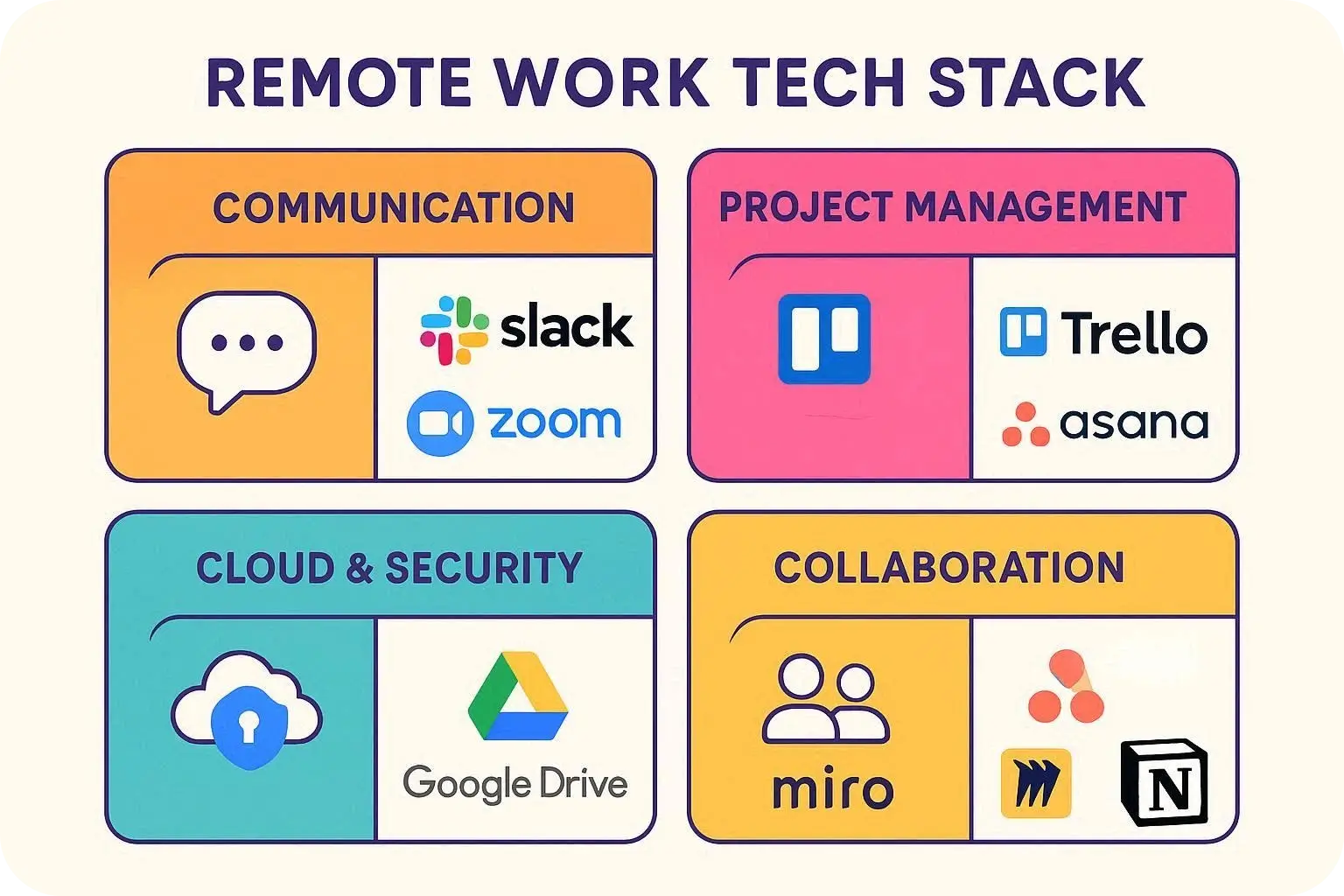
Collaboration Tools:
- Slack: Team communication hub. Create channels by project, department, or topic
- Zoom: Video conferencing for meetings and presentations
- Google Workspace: Shared documents, spreadsheets, presentations, and forms
- Notion: Knowledge management, documentation, and project tracking
- Asana/Trello/Monday.com: Project management and task tracking
Marketing Automation:
- HubSpot: All-in-one platform for email, CRM, automation, and analytics
- Marketo: Enterprise marketing automation (primarily B2B)
- ActiveCampaign: Email marketing and automation for small-medium businesses
- Zapier: Connect different tools and automate workflows
Analytics Platforms:
- Google Analytics: Website traffic and behavior analysis
- Google Tag Manager: Implement tracking without coding
- Hotjar: Heatmaps and session recordings
- Mixpanel: Product analytics and user behavior tracking
SEO Tools:
- Ahrefs: Keyword research, backlink analysis, and competitive intelligence
- SEMrush: All-in-one SEO and competitive research platform
- Google Search Console: Monitor search performance and technical issues
- Screaming Frog: Technical SEO auditing
Content Creation:
- Canva: Design graphics, presentations, and social media content
- Figma: Professional design and prototyping
- Grammarly: Writing assistant and grammar checker
- Hemingway Editor: Improve clarity and readability
- CapCut: Video editing (free and powerful)
AI-Powered Tools:
- ChatGPT: Content ideation, drafting, and editing
- Jasper: AI copywriting for ads and marketing materials
- Copy.ai: Generate marketing copy quickly
- Midjourney: Create AI-generated images
Social Media Management:
- Hootsuite: Schedule and manage multiple social accounts
- Buffer: Simple social scheduling and analytics
- Sprout Social: Enterprise social media management
Email Marketing:
- Mailchimp: Popular email platform for beginners
- ConvertKit: Creator-focused email marketing
- Klaviyo: E-commerce email and SMS automation
CRM Systems:
- Salesforce: Enterprise customer relationship management
- Pipedrive: Sales-focused CRM for small-medium businesses
- HubSpot CRM: Free CRM integrating with HubSpot’s marketing tools
You don’t need every tool immediately. Start with free versions. Master fundamentals before upgrading to premium plans.
Crafting Your Remote Marketing Job Search Strategy:
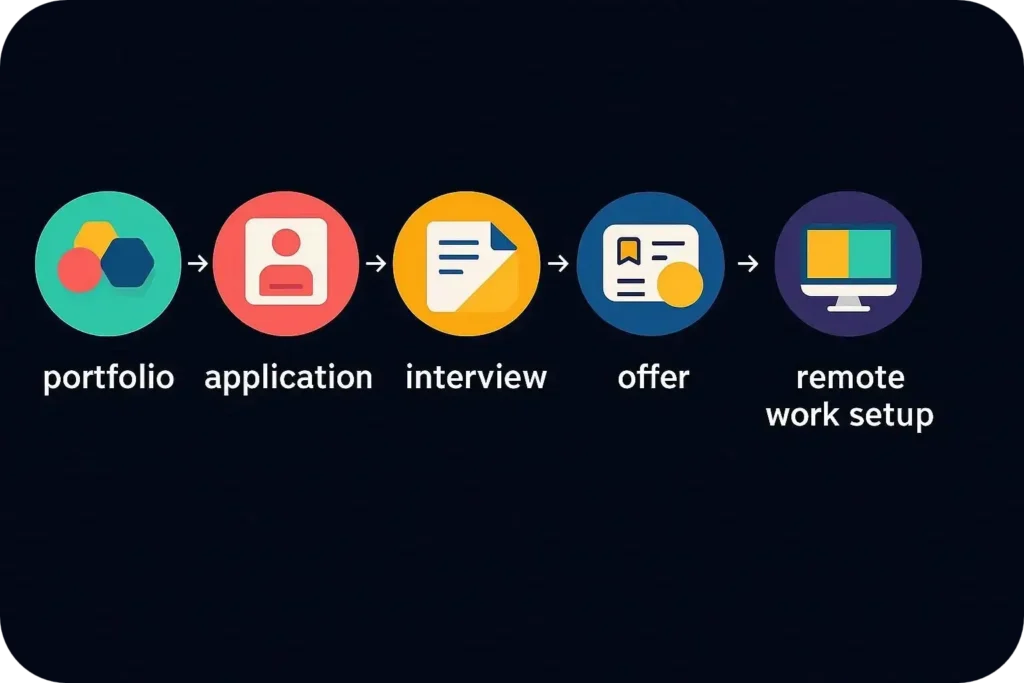
Note that remote marketing jobs requires different tactics than traditional job searches.
Optimizing Your Resume & Portfolio for Remote Roles
Resume Optimization:
Traditional resumes list responsibilities. Winning resumes showcase results.
Bad: “Managed social media accounts” Good: “Grew Instagram following from 2,500 to 18,000 in 8 months through strategic content calendar and engagement initiatives, resulting in 40% increase in website traffic from social“
Quantify everything. Use percentages, dollar amounts, and timeframes.
Include relevant keywords from job descriptions. Applicant tracking systems scan for terms like “Google Analytics,” “SEO,” “campaign management,” and “email marketing.“
Add a “Remote Work Experience” section highlighting:
- Years working remotely or managing distributed teams
- Tools you use for collaboration (Slack, Zoom, Asana)
- Results achieved while working from home
- Time zone management experience
Portfolio Development:
Marketing portfolios prove capability better than resumes ever could.
Include:
- Campaign case studies with before/after metrics
- Content samples (blog posts, social copy, email campaigns)
- Design work (graphics, landing pages, presentations)
- Analytics screenshots showing performance improvements
- Client testimonials or manager recommendations
Host your portfolio on personal websites using WordPress, Webflow, or Notion.
Cover Letter Strategy:
Most candidates skip cover letters or write generic ones. Big mistake.
Effective cover letters:
- Reference specific details from the job posting
- Explain why you’re drawn to THIS company specifically
- Share a relevant success story demonstrating required skills
- Express genuine enthusiasm for remote work
- Keep length under 300 words
Always write thoughtful cover letters. They help candidates stand out from identical-looking resumes.
Effective Remote Job Boards and Platforms
We may be biased but signing up for FREE Remote Jobs Central Newsletter can be your BEST CHOICE (where we send you curated worldwide remote marketing jobs). Of course, you don’t have to take our word for granted – Please see our reviews.
Networking Platforms:
- Twitter: Follow marketing leaders. Engage thoughtfully.
- LinkedIn Groups: Join relevant marketing communities.
Networking in a Remote World
Virtual Networking Strategies:
Networking feels harder remotely, but opportunities abound if you know where to look.
LinkedIn Optimization: Your profile is your digital handshake. Optimize your headline beyond job title. Post valuable insights weekly. Comment thoughtfully on others’ posts. Send personalized connection requests referencing shared interests.
Virtual Events: Attend online conferences, webinars, and workshops. Participate actively in chat. Connect with speakers and attendees afterward.
Online Communities: Join Slack groups, Discord servers, and Reddit communities focused on marketing. Contribute helpful answers. Build reputation over time.
Coffee Chats: Request 15-minute virtual coffee meetings with people in roles you want. Most people enjoy sharing their journey. Prepare thoughtful questions.
Informational Interviews: Reach out to marketing managers at companies you admire. Ask about their remote culture, team structure, and advice for candidates.
Content Creation: Start a marketing blog, YouTube channel, or LinkedIn newsletter. Share insights from your experience. This attracts opportunities organically.
Understanding Employer Expectations for Remote Marketing Talent
What Employers Look For:
Proven Self-Direction: Can you manage projects independently? Employers want evidence you don’t need hand-holding. Share examples of self-initiated projects or times you identified and solved problems proactively.
Communication Skills: Remote work is 80% communication. Employers assess how clearly you write emails, present ideas, and ask questions during interviews.
Results Orientation: Employers care about outcomes, not activity. Demonstrate you measure success by impact, not busyness.
Technical Competency: You must hit the ground running. Employers rarely train on basic tools. List specific platforms you’ve used with proficiency levels.
Cultural Fit: Remote teams need cohesion despite distance. Show you’re collaborative, positive, and adaptable.
Time Zone Considerations: Some roles require specific hours. Others offer flexibility. Clarify expectations upfront to avoid mismatches.
Red Flags Employers Watch For:
- Vague descriptions of past work without metrics
- Inability to articulate your process or methodology
- Poor communication during the interview process
- Unrealistic salary expectations without justification
- No questions about the role, team, or company culture
Acing the Remote Interview Process:
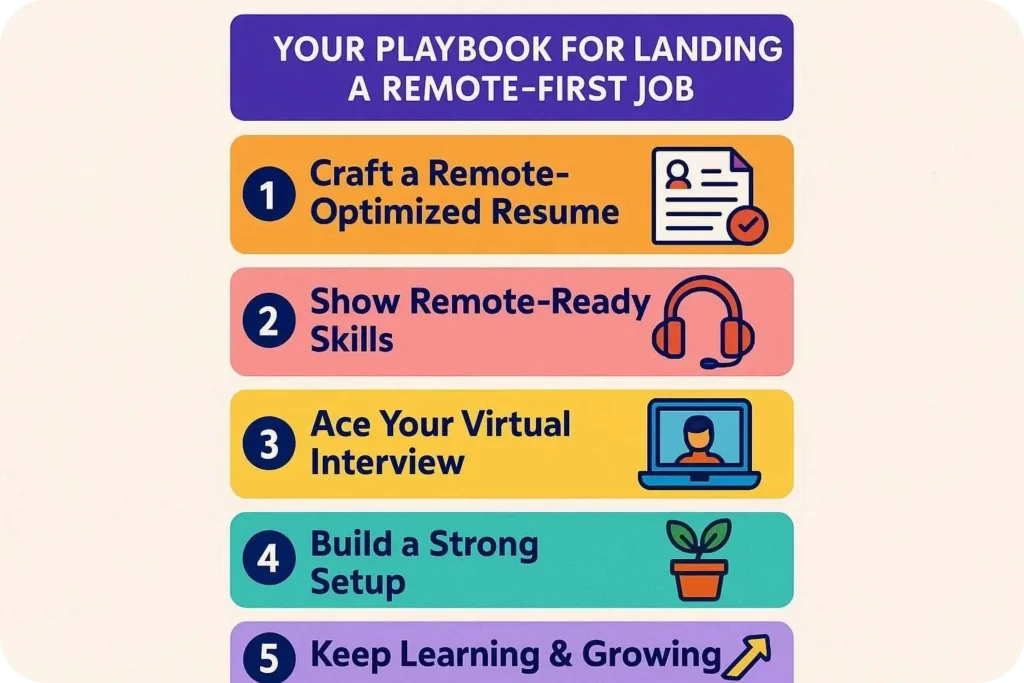
Preparing for Virtual Interviews
Technical Setup:
Nothing sabotages interviews faster than technical problems.
Test everything 30 minutes before your interview:
- Camera angle and lighting (face camera, use natural or ring light)
- Audio quality (use headphones with mic)
- Internet connection (run speed test, have backup mobile hot spot)
- Background (clean, professional, or virtual background)
- Zoom/Google Meet functionality (update software)
Keep your phone nearby with interviewer’s contact info in case tech fails.
Research the Company:
Spend 2-3 hours researching before interviews:
- Read recent blog posts and social content
- Study their products or services
- Review their marketing approach and identify opportunities
- Check LinkedIn for team members and company updates
- Read Glassdoor reviews for insider perspectives
- Prepare 5-7 thoughtful questions about role, team, and culture
Practice Common Scenarios:
Record yourself answering interview questions. Watch playback. Identify verbal tics, filler words, and body language issues.
Practice explaining your background in 60 seconds. Rambling loses attention quickly in virtual settings.
Prepare Your Environment:
- Silence phone and computer notifications
- Close unnecessary browser tabs and applications
- Put a “Do Not Disturb” sign on your door
- Inform household members about your interview
- Have water nearby (dry mouth happens when nervous)
- Keep resume, job description, and notes visible, but off-camera obviously 😜
Common Remote Marketing Interview Questions

“Why do you want to work remotely?”
Bad answer: “I hate commuting and want flexibility.”
Good answer: “I’m most productive in focused, distraction-free environments. Remote work lets me structure my day around deep work during peak energy hours. In my last role, I increased output 35% after transitioning to remote because I could dedicate uninterrupted time to strategy and analysis.“
“How do you stay productive working from home?”
Share specific systems: “I use time-blocking to schedule focused work sessions. My mornings are reserved for creative tasks like content creation and strategy. Afternoons handle meetings and collaborative work. I track tasks in Asana and use the Pomodoro technique for concentration. I also maintain a dedicated workspace that helps create psychological boundaries between work and personal time.”
“Describe a challenging remote project you managed.”
Use the STAR method (Situation, Task, Action, Result): “At my previous company, I managed a product launch campaign with team members across four time zones. We needed coordinated content releases, social promotion, and email sequences. I created a shared project timeline in Notion, scheduled async check-ins via Loom videos, and used Slack channels for quick updates. We launched on time, generated 1,200 qualified leads in the first month, and the approach became our template for future launches.”
“What tools do you use for remote collaboration?”
List specific platforms with context: “For communication, I rely on Slack for quick questions and async updates. I use Zoom for face-to-face meetings where tone matters. Google Docs enables real-time collaboration on strategy documents. Asana helps me track project progress and deadlines. For analytics, I primarily use Google Analytics and Ahrefs. I’ve also worked with HubSpot for email automation and Canva for quick graphic creation.”
“How do you handle miscommunication in remote settings?”
Show emotional intelligence: “I assume positive intent first. If a message seems unclear or concerning, I request a quick video call rather than continuing over text where tone gets lost. I also over-communicate by summarizing decisions in writing after verbal discussions. When I make mistakes, I acknowledge them quickly and transparently.”
“Tell me about a marketing campaign you’re proud of.”
Prepare 2-3 detailed case studies showcasing different skills:
“I developed a content strategy for a SaaS startup struggling with organic traffic. After keyword research using Ahrefs, I identified low-competition, high-intent topics our competitors missed. I created a 12-article content cluster around our main product feature. Each article targeted specific pain points and linked to a central pillar page. Within six months, organic traffic increased 220%, we ranked on page one for eight target keywords, and content-driven leads grew from 15 to 65 monthly. The campaign cost just $8,000 but generated $180,000 in new revenue.”
“What’s your experience with [specific tool or skill from job description]?”
Never lie about proficiency. If you lack experience, accept that. It’s completely okay, because there isn’t anyone who knows everything. 😇
Answer like: “I haven’t used that specific tool, but I have extensive experience with similar platforms. I learn new marketing technology quickly. For example, I became certified in HubSpot within two weeks of starting my last role and built our entire email automation workflow within a month.”
“How do you measure marketing success?”
Show strategic thinking: “It depends on the goal. For brand awareness campaigns, I track reach, engagement, and share of voice. For lead generation, I focus on cost per lead, lead quality scores, and conversion rates through the funnel. For revenue-focused campaigns, I measure customer acquisition cost, lifetime value, and ROI. I always establish KPIs before launching campaigns and create dashboards that stakeholders can access for real-time performance monitoring.”
“Describe your content creation process.”
Walk through your methodology: “I start with audience research – what questions are they asking, what pain points need addressing? Then I conduct keyword research to identify search volume and competition. I outline the content structure before writing, ensuring logical flow. During creation, I focus on providing unique insights rather than regurgitating common advice. After drafting, I optimize for readability using Hemingway Editor. I add relevant visuals, optimize meta descriptions, and include internal links. Finally, I track performance and update content quarterly based on search trends and reader feedback.”
Questions YOU Should Ask:
- “What does success look like in this role after 3, 6, and 12 months?”
- “How does the marketing team collaborate remotely? What tools and rhythms do you use?”
- “What’s the biggest marketing challenge the company faces right now?”
- “How do you support professional development for remote employees?”
- “What’s your approach to work-life balance in a remote environment?”
- “Can you describe the team culture and how you maintain connection despite distance?”
Asking zero questions signals disinterest. Asking thoughtful questions demonstrates engagement.
Following Up and Negotiating for Remote Offers
The Follow-Up Email:
Send within 24 hours of your interview. Thank them for taking time to discuss the position with you. Let them know that you enjoyed learning about the role and the company and really excited about the opportunity to contribute to its success.
Salary Negotiation for Remote Roles:
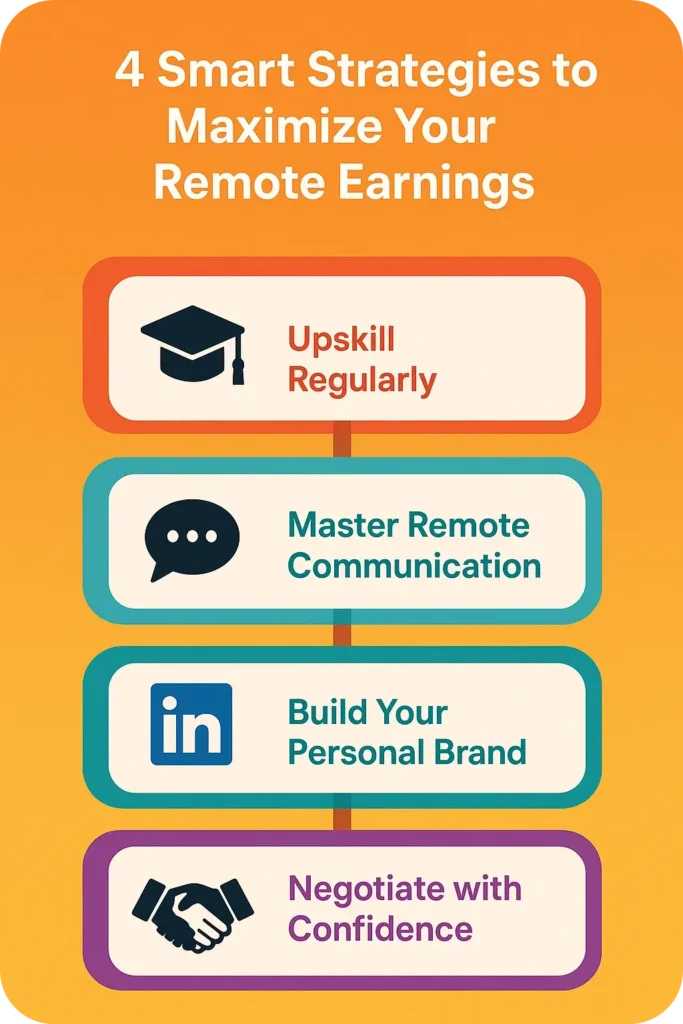
Research thoroughly before discussing compensation. Salaries vary based on:
- Company size and funding stage
- Your experience level
- Geographic location (some companies adjust for cost of living)
- Market demand for specific skills
Use resources like Glassdoor & PayScale to establish ranges.
When asked about salary expectations: “Based on my research and experience, I’m targeting $X-$Y for this type of role. However, I’m flexible and would love to hear what you have budgeted for the position. Total compensation including benefits, growth opportunities, and remote work arrangements all factor into my decision.”
Negotiation Tactics:
If the offer is lower than expected: “I’m excited about this opportunity and appreciate the offer. Based on my experience managing [specific relevant achievement] and the market rate for this skill set, I was expecting something closer to $X. Is there flexibility in the base salary?”
Consider negotiating beyond salary:
- Additional paid time off
- Professional development budget
- Equipment allowance for home office
- Performance bonus structure
- Stock options (for startups)
- Flexible hours or four-day work week
- Earlier performance review
Always get offers in writing before accepting. Review carefully for remote-specific policies around:
- Equipment provided vs. employee-purchased
- Internet stipend
- Time zone requirements
- Travel expectations for annual meetups
- Health insurance and benefits
Thriving in Your New Remote Marketing Role:
Landing the job is just the beginning. Long-term success requires intentional systems.
Setting Up Your Productive Home Office

Physical Space Design:
Your environment dramatically impacts productivity and well-being.
Dedicated Workspace: Separate work from living spaces if possible. I converted a spare bedroom into an office. If that’s not an option, use room dividers or designate a specific corner exclusively for work.
Ergonomic Setup: Invest in proper equipment. Sitting incorrectly for hours causes pain and reduces focus.
Must-haves:
- Adjustable chair with lumbar support
- Desk at proper height (elbows at 90 degrees when typing)
- External monitor at eye level (prevents neck strain)
- Keyboard and mouse (better ergonomics than laptop alone)
- Footrest if your feet don’t rest flat
Lighting: Position desk near natural light if possible. Add a ring light or desk lamp for video calls. Poor lighting causes eye strain and looks unprofessional on camera.
Technology Requirements:
- Reliable high-speed internet (minimum 50 Mbps download, 10 Mbps upload)
- Backup internet option (mobile hot spot)
- Quality webcam
- Noise-canceling headphones with microphone
- Surge protector for equipment
Psychological Environment:
- Remove distractions (TV, gaming console, household tasks)
- Add plants for improved air quality and mood
- Display motivational items or achievements
- Keep space clean and organized (clutter kills focus)
- Control temperature
Boundaries with Household Members:
Communicate your schedule clearly. When your door is closed, you’re unavailable except for emergencies. When you emerge for lunch, you’re open to conversation. Also have clear signals – headphones ON means “do not disturb.”
Mastering Remote Communication and Collaboration
Async Communication Best Practices:
Remote teams thrive on asynchronous communication – not everyone needs to be online simultaneously.
Write comprehensive messages:
- Provide context upfront
- State the issue or question clearly
- Include relevant background information
- Specify what you need and by when
- Attach supporting documents
Bad Slack message: “Hey, can we talk about the campaign?”
Good Slack message: “Hi! I need input on our Q2 content campaign targeting mid-market SaaS companies. I’ve drafted a content calendar (link) but want feedback on topic selection and publishing frequency before finalizing. Could you review by Thursday and share thoughts in the doc’s comment section? Happy to discuss sync if needed.”
Video Communication:
Use video strategically. Not everything needs a meeting, but certain situations benefit from face-to-face interaction:
- Complex topics requiring discussion
- Sensitive feedback or difficult conversations
- Team bonding and relationship building
- Kickoff meetings for new projects
- Celebrating wins together
Camera etiquette:
- Look at the camera, not your own image
- Minimize multitasking (people notice)
- Mute when not speaking in large meetings
- Use virtual backgrounds if your space isn’t presentable
Status Updates:
Over-communicate your progress. Remote managers can’t observe your work directly. Send brief daily updates in your team Slack channel. This takes 2 minutes but provides transparency and accountability.
Meeting Efficiency:
Remote meetings often waste time. Make yours productive:
- Always have a clear agenda shared beforehand
- Start and end on time
- Designate a facilitator to keep discussion on track
- Take notes in a shared document during the meeting
- End with action items, owners, and deadlines
- Record meetings for those who can’t attend
Time Zone Management:
Working across time zones requires flexibility and planning.
- Use tools like World Time Buddy to visualize overlapping hours
- Schedule meetings during overlap periods when possible
- Rotate meeting times to share inconvenience fairly
- Record important meetings for team members in different zones
- Set Slack status with your current time zone and working hours
Maintaining Work-Life Balance and Well-being

The Blurred Boundary Problem:
Remote work’s biggest challenge? Knowing when to stop working.
Your office is always accessible. It’s 8 PM and you think “I’ll just check email quickly.” Two hours later you’ll still be working.
Boundaries That Work:
Set Specific Hours: Decide when your workday starts and ends. Communicate these to your team. Stick to them.
Physical Transition Rituals: Create routines that signal work mode versus personal time.
Start of day: Make coffee, review priorities, sit at desk at 8:30 AM sharp. End of day: Save all files, close laptop, 5-minute walk outside, change clothes.
These rituals tell your brain “work is starting” or “work is finished.”
Separate Devices: If possible, use different computers or at least different user profiles for work and personal activities. This creates technological boundaries.
Regular Breaks:
Sitting for 8 hours destroys health and productivity.
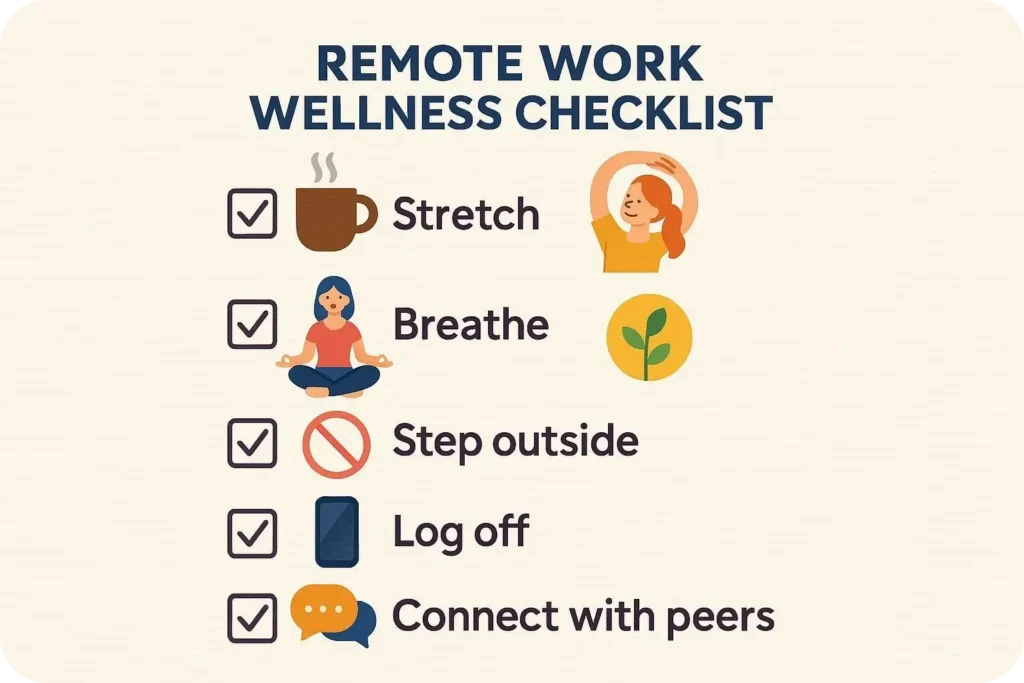
My break schedule:
- 10:30 AM: 10-minute walk outside
- 12:30 PM: 45-minute lunch away from desk
- 3:00 PM: 15-minute movement (stretching, quick workout, household task)
Breaks aren’t laziness – they’re productivity investments. I’m more focused after stepping away.
Physical Health:
Remote work risks: weight gain, back pain, eye strain, and poor posture.
Combat these through:
- Standing desk converter or adjustable desk
- Exercise before, during lunch, or after work
- Regular eye breaks using the 20-20-20 rule (every 20 minutes, look at something 20 feet away for 20 seconds)
- Hydration (keep water bottle at desk)
- Healthy snacks readily available
Mental Health:
Isolation affects mental well-being. Stay connected:
- Schedule virtual coffee chats with colleagues
- Join online communities in your field
- Work from coffee shops or co-working spaces occasionally
- Maintain friendships outside work
- Consider therapy if feeling persistently lonely or anxious
Avoiding Burnout:
Watch for warning signs:
- Chronic exhaustion despite sleeping
- Cynicism about your work
- Reduced productivity
- Physical symptoms (headaches, stomach issues)
Prevent burnout by:
- Taking all your paid time off (actually disconnecting)
- Saying no to unrealistic deadlines
- Delegating when possible
- Celebrating small wins
- Maintaining hobbies unrelated to work
Continuous Learning and Career Growth
Stay Current in Marketing:
Marketing evolves rapidly. What worked last year might be obsolete today.
Skill Development Priorities:
Focus learning on high-leverage areas:
- Master analytics deeply (data skills are incredibly valuable)
- Stay current with AI marketing tools (this is transforming the field)
- Develop strategic thinking beyond tactical execution
- Build leadership and mentoring abilities
- Improve presentation and stakeholder communication
Documentation and Knowledge Sharing:
Build your reputation by teaching others:
- Write blog posts about lessons learned
- Create LinkedIn posts sharing insights
- Contribute to team documentation
- Mentor junior marketers
- Speak at virtual events or webinars
Sharing knowledge positions you as an expert and attracts opportunities.
Career Progression in Remote Roles:
Growing your career remotely requires intention:
- Schedule regular 1-on-1s with your manager
- Request feedback proactively
- Document your wins and share them
- Volunteer for high-visibility projects
- Build relationships across departments
- Communicate your career goals explicitly
Create a “wins document” tracking every significant accomplishment with metrics. During performance reviews, reference specific examples rather than vague claims.
When to Consider a Job Change:
Know when it’s time to move on:
- You’ve stopped learning and growing
- Compensation doesn’t match market rates
- Company culture or values have shifted
- Work-life balance is consistently poor
- You’ve outgrown your role with no advancement path
Don’t stay too long out of comfort or loyalty. Your career is your responsibility.
Conclusion:
Your Journey to a Flexible Marketing Career
Recap of Key Takeaways for Finding Your Remote Marketing Job
Remote marketing jobs have transformed from rare exceptions to mainstream career paths. The opportunities span 50+ specializations – from content creation and SEO to paid advertising and marketing analytics.
Success requires both technical marketing skills and remote work competencies. Master the fundamentals of your chosen specialization while developing strong communication, time management, and self-direction abilities.
Your job search strategy matters as much as your qualifications. Optimize your resume with quantifiable results, build a portfolio showcasing real campaign outcomes.
The interview process tests both your marketing expertise and remote work readiness. Demonstrate proven results, communicate clearly, and show you understand the unique challenges of distributed collaboration.
Your Next Steps Towards a Flexible and Fulfilling Career
Ready to take the next step? Want exclusive access to the best remote marketing jobs, including opportunities with many super cool companies that you may have never heard of (but YOU SHOULD)? Then, Sign up to our FREE Remote Jobs Central newsletter to get the latest remote job listings directly in your inbox and also Subscribe to our YouTube channel for awesome videos with research backed insights and expert tips.
What’s the biggest challenge you face in your Remote Marketing Jobs search? Have you ever applied for one online? Share your experience in the comments below – let’s build a community of remote marketing professionals and support each other.
FAQ:
Can I get a remote marketing job?
Sure, getting a remote marketing job is absolutely achievable if you possess relevant skills and demonstrate self-direction, with positions like marketing coordinator or social media specialist offering accessible entry points. Start by building a portfolio showcasing measurable results from past campaigns (even if they’re from internships, freelance personal projects). Focus on mastering one core skill deeply – whether content creation, SEO, or paid advertising will highly increase your chances.
What are the most well paid remote jobs?
The highest-paying remote marketing positions include Chief Marketing Officer roles ($150,000-$300,000+), Marketing Directors ($100,000-$180,000), and specialized positions like Growth Marketing Managers ($80,000-$140,000) or Product Marketing Managers ($95,000-$150,000). Technical marketing roles such as Marketing Automation Managers also command premium salaries ($80,000-$125,000) due to their specialized skill requirements. Compensation varies based on experience, company size, industry, and whether employers adjust for geographic location.
Is marketing a well paid job?
Marketing is certainly a well paid job, with many roles offering competitive compensation that varies significantly by specialization and experience level. Entry-level marketing coordinators typically earn $40,000-$55,000, mid-level specialists and managers earn $60,000-$110,000, while senior positions and specialized roles command $85,000-$150,000+. High-demand specializations like growth marketing, marketing analytics, and product marketing often pay above-average salaries. Your earning potential increases substantially as you develop expertise, demonstrate measurable ROI, and take on strategic responsibilities.
Are remote marketing jobs in high demand?
Remote marketing positions remain in exceptionally high demand, with postings increasing substantially after COVID. Companies recognize that marketing functions perform effectively in distributed environments since most tools and platforms operate cloud-based. The shift to digital-first business strategies has certainly intensified demand for skills in SEO, content marketing, paid advertising, and marketing automation.
What is the best marketing job to work remotely?
The best remote marketing roles depends on your strengths and lifestyle preferences. Content marketing and SEO positions offer exceptional flexibility since you can write and optimize whenever creativity strikes. Marketing analytics roles suit detail-oriented professionals who enjoy working independently with data. Social media management provides variety but requires consistent presence during audience engagement peaks.
What do remote marketing jobs do?
Remote marketing professionals drive customer acquisition, engagement, and retention through digital channels. Daily responsibilities vary by specialization but typically include creating content strategies, managing advertising campaigns, analyzing performance data, optimizing conversion paths. Content marketers produce blog posts and resources, SEO specialists improve search rankings, PPC Specialists optimize ad spend, and email marketers nurture customer relationships through automated sequences.
How do I get started in remote marketing?
Well, you can get started by identifying which marketing specialization aligns with your natural strengths like analytical, creative, or strategic thinking. Complete free certifications from Google, HubSpot, or Facebook to build knowledge & demonstrate expertise. Create portfolio pieces by offering services to local businesses, non-profits, or through freelance platforms at competitive rates.
Is marketing a stressful job?
Well, yes and no, actually! Marketing jobs stress levels vary considerably by role type, company culture, and work-life boundaries. While fast-paced environments like startups or agencies often involve tight deadlines, changing priorities, and high-pressure campaigns.Roles focused on creative strategy typically feel less stressful than positions requiring constant real-time monitoring. Success depends on choosing environments matching your stress tolerance and establishing healthy boundaries.