100 Percent Remote Jobs: 9 Proven Paths to Success
Summary:
100 percent remote jobs let you earn a paycheck with no office and no required trips in. This guide shows what the term means, who hires, how to apply, and how to spot fake offers before they cost you money.
Key Takeaways:
- 100 percent remote jobs have zero office days, which sets them apart from hybrid and remote-friendly roles.
- Job posts use five labels. Learn them before you apply, because only some match fully remote jobs.
- Entry-level remote jobs with no experience exist in support, data entry, writing and virtual assistant work.
- Real 100 percent remote jobs never ask you to pay a fee, buy gear from them or cash a check.
- Run the 5-Question Truth Test on every post. It takes about five minutes.
- Pay math helps. $2,000 a month is about $11.50 an hour full time.
- Fully remote is not for everyone, even though 100 percent remote jobs are popular. Only 24% of hybrid workers would pick it all the time.
- Join the Remote Jobs Central free newsletter for fresh remote job leads.
Introduction:
What Are 100 Percent Remote Jobs?
100 percent remote jobs are paid roles where you do all of your work away from a company office. You never have to come in. Not for a meeting, not for a party, not for a required yearly trip. The word “fully” matters here. A job that asks for two days a week in an office is hybrid, not fully remote.
People search for this idea in many ways: fully remote jobs, remote-only jobs, completely remote jobs and permanent remote jobs. They all point to the same thing. Your home, a library or a cafe becomes your office. Some roles let you work from anywhere in the world, but that is a different promise, and I will explain the gap soon.
The Who, What, When, Where and Why
- Who: Employers of every size, from tiny startups to large firms, hire for these roles.
- What: Real jobs with real pay, in fields like support, writing, sales and software.
- When: Some roles set fixed hours. Others let you pick your own schedule.
- Where: Your home, or any place with a good internet link.
- Why: Companies save on office costs and reach more talent. You save time and gain flexible hours.
Is a work from home job the same as one of the 100 percent remote jobs you see online? Close, but not always. Some work from home roles still need a few office days or a trip to sign papers. A true fully remote role never does. Say it out loud to the recruiter, and get the answer in writing.
But here is the catch most posts hide. “Remote” is not one thing. It comes in five flavors, and only some match what you want. Which ones? Let me show you.
100 Percent Remote Jobs vs Hybrid and Remote-First
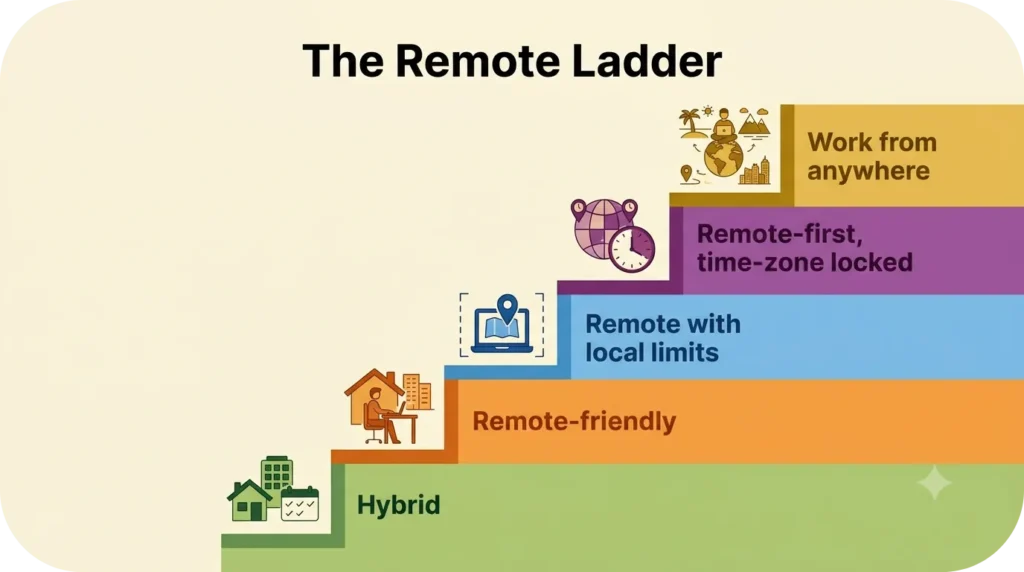
I call this the Remote Ladder. Job posts use five labels, and each one makes a different promise. Read the table from the bottom up, from most office time to most freedom.
| Label in the post | What it often means | Is it 100 percent remote? |
|---|---|---|
| Hybrid | Some office days each week | No |
| Remote-friendly | An office exists, home work is allowed | No |
| Remote with local limits | No office, but you must live in set states or one country | Yes, with limits |
| Remote-first, time-zone locked | No office, but you work set hours in one time zone | Yes |
| Work from anywhere | No office, any place, flexible hours | Yes, the widest type |
Last spring, I took a call with a hiring manager. The talk went like this:
“Is this role 100 percent remote?” “Yes, but you must live in Ohio.”
That was a remote job with local limits. It was fine for me to know, but it would have wasted a week if I had lived in Texas. Always ask this one question before you apply: “Where must I live, and which hours must I work?“
The shift is real. A Pew Research Center survey found that 75% of workers with jobs that can be done from home do it at least some of the time. Yet many bosses now ask for office days, so the fully remote group is smaller than you might think. That is why a clear label matters.
So who still hires fully remote, and in what places? Let us find out.
Which Companies Offer 100 Percent Remote Jobs Worldwide?
Firms that post 100 percent remote jobs often run with no central office at all. Automattic, TestGorilla, MailerLite and Bunny are well-known examples. Others, like Toggl and Sticker Mule have recently posted roles with an “anywhere in the world” tag on public boards. Open roles change fast, so use these names as a starting list and check each career page for today’s openings.
100 Percent Remote Jobs Worldwide: The 3 Hidden Filters

A post for 100 percent remote jobs that says “anywhere” can still hide three filters. Check each one before you apply.
- Time zone. Many teams want four hours of overlap with the main team. A “work from anywhere” role may still need you awake at 2 a.m.
- Payroll. Some firms hire you as a contractor. Others use a partner that pays staff in many countries. This changes taxes and benefits.
- Right to work. Some roles need legal work rights in a set country, even if you never visit.
100 Percent Remote Jobs USA, UK and India
In the 100 percent remote jobs USA market, watch for state limits. A firm may hire only where it has a tax setup. In the UK, contractors should learn the off-payroll rules called IR35 before they sign. For 100 percent remote jobs India, ask about pay in US dollars, time-zone overlap and how the firm pays you. I am not a tax or legal advisor, so talk to a pro before you sign any contract.
Your country is only one filter. Your field is the other. Which fields hire the most fully remote staff? The next section has nine of them.
Best 100 Percent Remote Jobs by Field
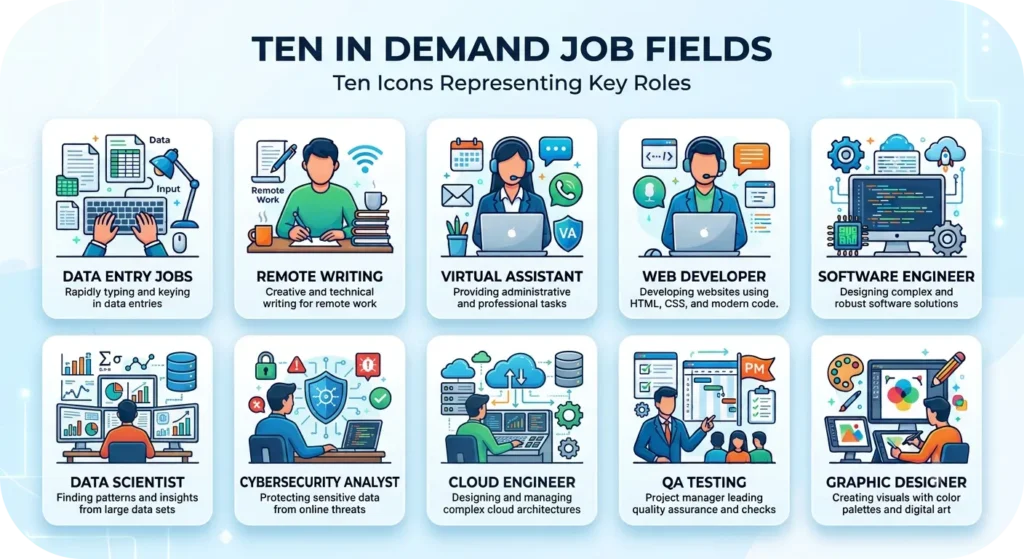
These are the in-demand fully remote jobs I see most often. Each one ranks high for volume. I picked nine paths, and each links to a full guide on our blog.
| Path | Good for | Typical work | Entry level? |
|---|---|---|---|
| Data entry jobs | Detail lovers | Typing, checking and sorting records | Yes |
| Remote writing | Word fans | Blogs, emails, ads and reports | Yes, with samples |
| Virtual assistant | Organizers | Calendars, inboxes, research | Yes |
| Web developer | Builders | Sites and web apps | Some roles |
| Software engineer | Problem solvers | Code, tests and fixes | Rarely |
| Sales roles | Talkers | Calls, demos and deals | Some roles |
| QA testing | Bug hunters | Testing apps before launch | Yes |
| Project management | Planners | Plans, tasks and deadlines | Rarely |
| Product management | Big-picture thinkers | Choosing what to build | Rarely |
Think of this table like a menu. You do not need to order everything. Pick one path that fits your skills and build proof for it. A small sample, like a test report or a writing piece, often beats a long resume.
Other fields hire fully remote staff too, such as 100 percent remote nursing jobs for phone triage, 100 percent remote accounting jobs, 100 percent remote HR jobs and customer support. Rules vary by license and state, so read each post with care.
But what if you have no work history at all? That is the next big question, and the answer is better than you might expect.
100 Percent Remote Jobs With No Experience
Yes, 100 percent remote jobs with no experience exist, and so do 100 percent remote jobs entry level posts for people with a thin resume. They are not easy to land, but they are real. The best starting points are customer support, data entry, chat support, transcription, junior QA testing and virtual assistant work. These roles teach skills fast and ask for little proof.
You might be thinking, “But every post asks for two years of experience.” Here is the truth. Many posts list a wish list, not a hard rule. If you meet about 60% of the list, apply anyway. Hiring teams care about proof you can do the work.
How to Build Proof in 14 Days
- Pick one role from the table above.
- Do three small practice tasks. For a virtual assistant, sort a messy inbox and write a summary. For QA, test a free app and write a bug report.
- Save the work in one shared page.
- Add a link to your resume.
This works for entry level remote jobs and for remote jobs for freshers. It shows you can learn, finish tasks and write clearly. Those are the skills remote managers want most.
Keep one rule in mind. Quality beats volume. Three strong samples are worth more than ten weak ones, and a hiring manager can judge them in two minutes. That is how many new applicants win 100 percent remote jobs against bigger resumes.
One warning. Posts that promise big pay with no skill at all are the same posts scammers love. I will show you how to test them soon. First, let us sort the job types, because pay works very differently in each.
Full-Time, Part-Time and Contract Remote Jobs
Full-time remote jobs often come with set pay. Full-time 100 percent remote jobs sometimes add remote jobs with benefits, such as health cover and paid leave. Part-time 100 percent remote jobs give you fewer hours and more freedom. Contract roles pay for a task or a time period, and you usually handle your own taxes and cover.
How to Make $2,000 a Month Working From Home
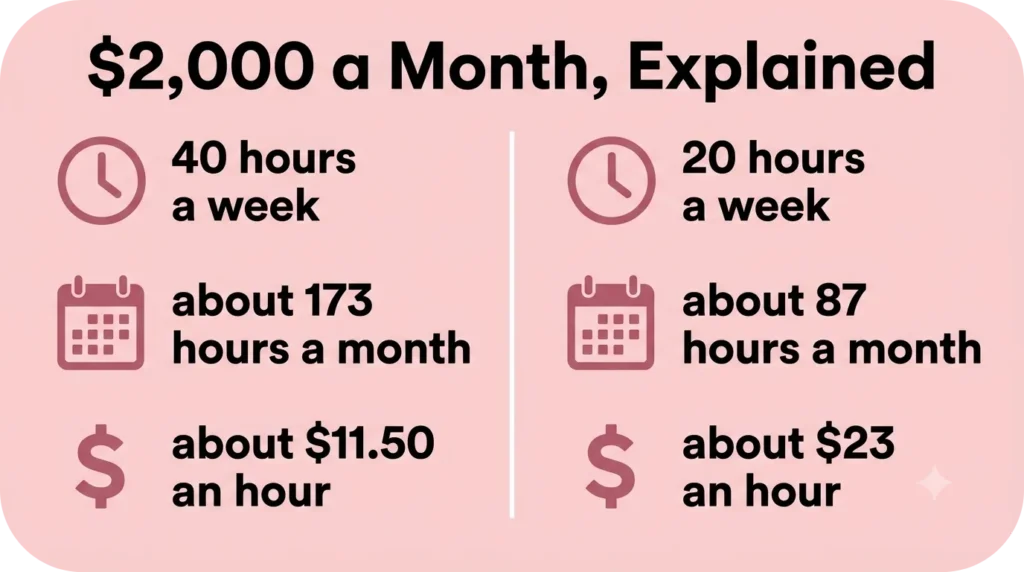
Let us do the math. There are about 173 work hours in a month at 40 hours a week. So $2,000 a month is about $11.50 an hour. At 20 hours a week, it is about $23 an hour. That means a part-time role in a skilled field can reach this goal, and a full-time entry role can too.
Why a $4,000 a Week Offer Is a Red Flag
Now try the other number. $4,000 a week is $208,000 a year. Very few roles pay that, and almost none ask for no degree and no skill. If a post promises this, treat it as bait. Real high pay comes with real skills, a long hiring process and a named employer.
Analogy time: a job post is like a house listing. A fair price and clear photos seem safe. A mansion for $50 a month should make you stop and ask why.
Which type should you pick? Full-time gives steady pay. Part-time gives room to learn. Contract gives choice but less safety. Your life and goals decide it. Now the big question: where do you find these roles in the first place?
Where to Find Legit 100 Percent Remote Jobs
We may be biased but signing up for FREE Remote Jobs Central Newsletter can be your BEST CHOICE (where we send you curated worldwide remote jobs). Of course, you don’t have to take our word for granted – Please see our reviews.
How to Tell a Legit Job Board From a Weak One
The question “what are the best 100 percent remote job boards and legit sites?” gets asked a lot. Instead of a list that goes stale, use five checks:
- It is FREE for job seekers.
- Each post names the employer.
- Apply links lead to the company’s own site.
- People love & trust the service and leave genuine reviews. Please see our reviews.
A board that fails two of these should not get your time. Now, even a good board can slip. What do you do when a post looks right but something is off? That is where my test comes in.
How to Spot Fake 100 Percent Remote Jobs
Fake 100 percent remote jobs hurt real people. The FTC reports that people lost more than $12.5 billion to fraud in 2024, and job offers sit in that mix. The agency warned about “task scams,” where you are paid small amounts to click or rate things, then asked to send money to get paid more. Reports of them grew from about 5,000 in 2023 to about 20,000 in the first half of 2024.
The 5-Question Truth Test
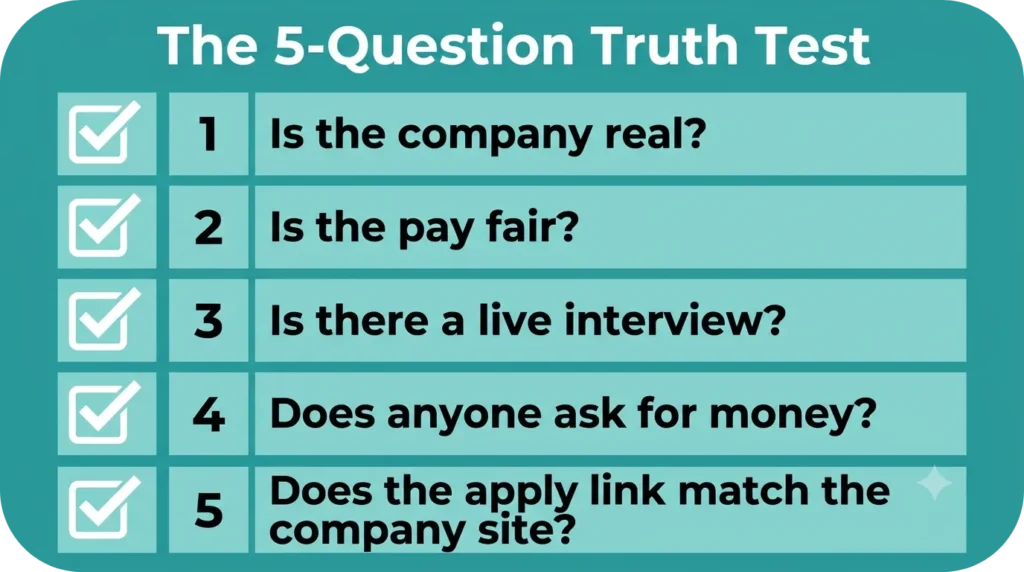
Run every post through these five questions:
- Is the company real? Find its own website, staff on a work profile site and news about it.
- Is the pay fair for the work? Compare with similar roles.
- Is there a live interview? Real teams talk to you on video or phone, not only in a chat app.
- Does anyone ask for money? No fees, no gift cards, no crypto, no “equipment” checks to cash.
- Does the apply link match the company’s domain? If not, stop.
One “no” on questions 1, 3 or 5 is a stop sign. A “yes” on question 4 is a hard stop sign, full stop.
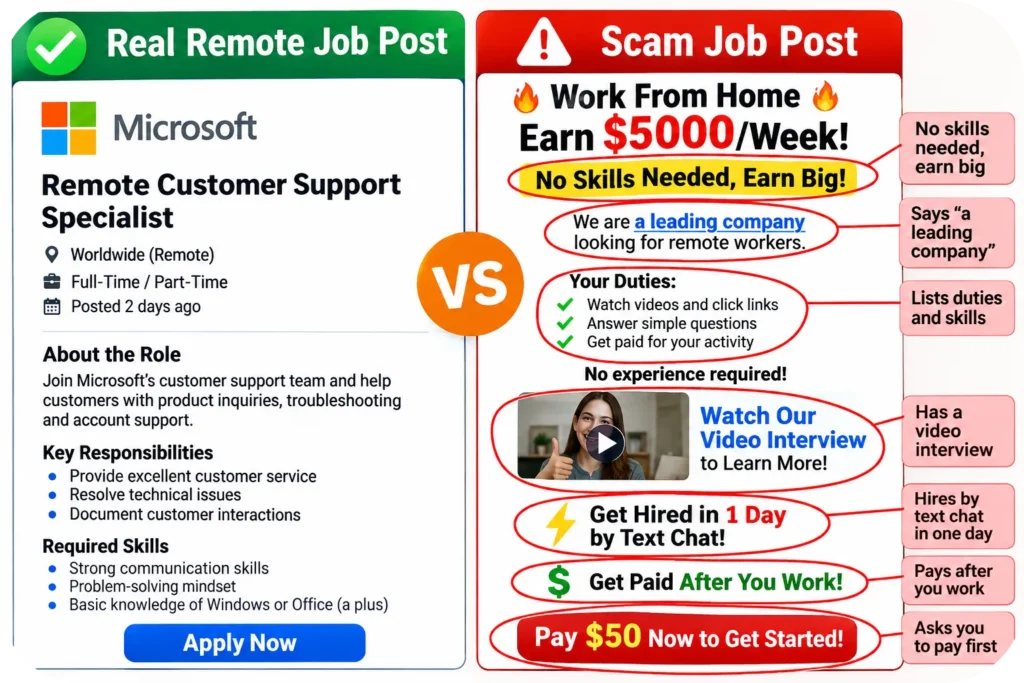
| Real post | Scam post |
|---|---|
| Names the employer and team | Says “a leading company” |
| Lists duties and skills | Says “no skills needed, earn big” |
| Has a video interview | Hires by text chat in one day |
| Pays after you work | Asks you to pay first |
What to Do If You Spot One
Stop all contact. Do not click links. Report it to the FTC. If you sent money, call your bank right away.
Spotting scams is half the game. The other half is winning the real ones. What makes a strong application?
How to Apply for Fully Remote Jobs
The best 100 percent remote jobs go to people who write well, work alone and finish tasks. Show those three things.
- Rewrite your resume for the role. Use words from the post, and match the exact title of the 100 percent remote jobs you want. Add remote skills like asynchronous work, chat tools, project boards and video calls.
- Write a short note. Four sentences is enough. Say who you are, what you can do and one proof link.
- Prepare your space. A quiet room, a good webcam and a steady internet link signal that you are ready. Test them before the call.
- Practice online interviews. Face the camera, speak clearly and keep notes close.
- Plan your pay talk. Check the going rate, set a range and ask about health benefits and paid time off.
- Follow up. A short thank-you within a day sets you apart.
When I started, I sent 40 applications and heard back from three. All three had one thing in common: a proof link at the top of my note. That small change did more than any resume tweak. Many teams test your writing, so answer every email like a pro. Hiring managers read hundreds of apps. A clear, kind and short one stands out.
You might be thinking, “Should I even want a fully remote job?” Fair question. Let me give you the honest view, including what most guides skip.
Benefits, Trade-Offs and Who Should Skip Fully Remote Work
The upsides are real. You save commute time and money. You often pick your own hours. A Pew Research Center survey from 2023 found that 71% of people who work from home say it helps them balance work and life. Your hiring pool widens too, because you can apply to firms in other cities and countries.
Now the part most guides skip about 100 percent remote jobs. Fully remote work is not for everyone. Pew found that only 24% of hybrid workers would choose to work from home all the time if they could pick. Some people miss the buzz of a shared room. Others struggle to switch off at night, since the office is always one room away.
Here are three signs you may do better in a hybrid role:
- You get your energy from people around you.
- You find it hard to start tasks alone.
- Your home is loud or small.
If these fit you, that is fine. Many workers do well with two office days. If they do not fit, a flexible remote job could be your best match.
To try it safely, start with a short contract or a part-time role. Set a work space, fixed hours and one weekly chat with another person. This gives you data about yourself before you commit.
The right way to pick is simple. Use the Remote Ladder to find the label, the Truth Test to check the post and your own habits to choose the role. That is how you land one of the 100 percent remote jobs that fits your life. Pick one of the best 100 percent remote jobs for your skills, and take the first step this week.
Conclusion:
Finding 100 percent remote jobs is a real path, but it rewards people who ask sharp questions. You now know the five labels, the nine top fields, the pay math and the five-question test. These tools protect your time and your money.
Picture your first day: coffee at home, a clear task list and no commute. That outcome is within reach when you pick a field, build small proof and apply with care.
Ready to take the next step? Want exclusive access to the best 100 percent remote jobs, including opportunities with many super cool companies that you may have never heard of (but YOU SHOULD)? Then, Sign up to our FREE Remote Jobs Central newsletter to get the latest remote job listings directly in your inbox and also Subscribe to our YouTube channel for awesome videos with research backed insights and expert tips.
What is the first question you will ask on your next remote job post? Share it in the comments.
FAQ:
Which company is 100% remote?
Several companies run with no central office, and Automattic, GitLab and Zapier are well-known examples. Open roles change often, so check each career page for current jobs before you plan around one.
What jobs can be done 100% remotely?
Many jobs can be done as 100 percent remote jobs, including customer support, writing, data entry, virtual assistant work, web development, QA testing, sales and project management. Some licensed roles, like nursing and accounting, have remote posts too, but rules vary by place.
How can I make $2000 a month working from home?
You can reach $2,000 a month in 100 percent remote jobs with about $11.50 an hour at full time, or about $23 an hour at 20 hours a week. Roles like support, data entry, writing and virtual assistant work are common starting points.
What jobs pay $4000 a week without a degree?
Almost none do. A $4,000 weekly offer equals $208,000 a year, and real roles at that level ask for deep skill and a long hiring process. Treat a no-skill offer of that kind as a likely scam.